




An Evolution from Landing Legs
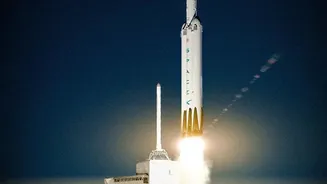
Anyone who has followed spaceflight in the last decade has seen the iconic footage: a SpaceX Falcon 9 booster descending from the sky to land perfectly upright on its own legs. This innovation turned the economics of spaceflight on its head. For its next-generation
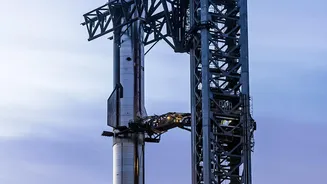
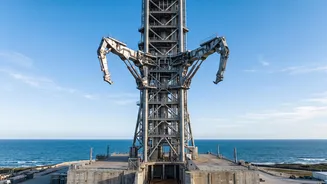
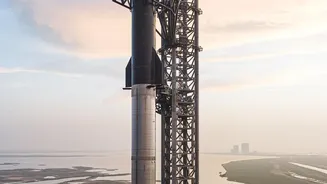
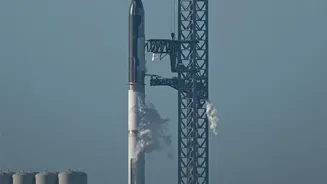
Starship system, however, SpaceX is taking a radically different approach. Instead of the rocket landing itself, the launch tower will catch the returning Super Heavy booster before it even touches the ground. This method, using two large arms on the launch integration tower nicknamed 'Mechazilla', might seem absurdly complex, but the reasons behind it are rooted in ruthless efficiency and a long-term vision for humanity's future in space.
How the Catch System Works
The process is an incredible feat of engineering precision. After the Super Heavy booster separates from the upper-stage Starship, it performs a series of engine burns to flip around and fly back to the launch site. As it approaches the 480-foot-tall tower, it fires its Raptor engines one last time, slowing to a near-hover beside the structure. At this moment, the two large 'chopstick' arms, guided by a host of sensors and precision control systems, move to close around the booster. They don't grab the body of the rocket, but instead engage with strong points built into the booster just below its large grid fins. The engines cut off, and the massive rocket is left cradled in the arms of the tower that launched it, all just minutes after liftoff.
The Core Benefit: Mass Savings
The most significant advantage of the tower-catch strategy is the reduction of mass on the rocket itself. Landing legs, especially ones strong enough to support the immense weight of a Super Heavy booster, are incredibly heavy. They require structure, hydraulics, and robust deployment mechanisms. By moving all that hardware from the rocket to the ground-based launch tower, SpaceX strips tons of dead weight from the vehicle. Every kilogram saved on the rocket's structure is a kilogram that can be used for something else—more fuel, more scientific instruments, or more cargo for missions to the Moon and Mars. This mass efficiency is a critical factor in making interplanetary travel viable.
Accelerating the Path to Reuse
The second major driver for this strategy is speed. SpaceX’s ultimate goal is not just reusability, but rapid reusability, with turnaround times more like an airline than a traditional space program. Catching the booster directly on the launch mount eliminates several time-consuming steps. There is no need to recover a booster from a drone ship at sea or transport it from a separate landing pad back to the launch site. In theory, once caught, the booster can be almost immediately inspected, placed back on the launch mount, stacked with a new Starship upper stage, and refueled for another flight within hours. This high launch cadence is essential for SpaceX's ambitious plans, such as assembling fuel tankers in orbit to support missions to Mars.
Simplifying the Rocket Itself
While catching a rocket with a tower seems more complicated, it dramatically simplifies the design of the flight hardware. The booster no longer needs a complex, heavy, and potentially fallible landing leg system. This not only saves weight but also removes multiple potential points of failure from the vehicle. The rocket is optimized purely for flight, while the tower, which doesn't have to fly, can be made as robust and powerful as necessary to handle the loads of catching and lifting. It's a fundamental shift in philosophy: move complexity from the flight vehicle to the ground infrastructure wherever possible. This makes the part that flies leaner, simpler, and ultimately more reliable.
The Bigger Picture
The tower-catch strategy is a key enabler of SpaceX’s vision for Starship. The system is designed not just to launch and land, but to do so at a scale and frequency that could lower the cost to orbit to unprecedented levels. Achieving this requires a system that operates more like an assembly line, where recovery and preparation for the next flight are integrated seamlessly. While the challenge of perfecting this skyscraper-sized maneuver is immense, its success, first demonstrated in October 2024, is a pivotal step. It proves that the seemingly science-fiction concept is a workable engineering solution, paving the way for a future where access to space is routine and affordable.