



A Cosmic Speed Limit
First, let's get one thing straight: the delay isn't because sunlight is slow. In fact, it’s the fastest thing in the entire universe. Light travels at an incredible speed of approximately 300,000 kilometres per second. If you could travel that fast,
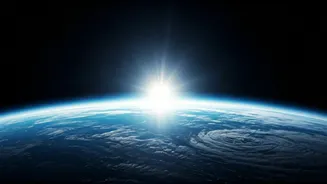
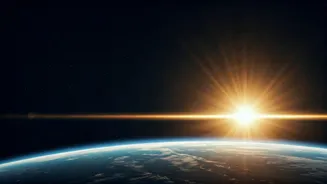
you could circle the Earth more than seven times in a single second. So, if the energy from the Sun is moving at the ultimate cosmic speed limit, why isn't its arrival instantaneous? The answer has nothing to do with speed and everything to do with scale. The delay is a direct consequence of the immense distance between our planet and its star.
The Sheer Scale of Space
The Earth orbits the Sun at an average distance of about 150 million kilometres. It’s a number so large that it’s difficult for our minds to truly grasp. Think of it this way: if you were to drive that distance in a car at a constant 100 km/h without stopping for anything, the journey would take you more than 170 years. Now, consider our beam of light, travelling at 300,000 km/s. When you do the maths (150,000,000 km divided by 300,000 km/s), you get 500 seconds. Convert that into minutes, and you arrive at approximately 8 minutes and 20 seconds. So, while the headline's 'eight full minutes' is a great rule of thumb, the precise travel time for a photon to complete its solar commute is just a little bit longer.
What Exactly Is Arriving?
The headline mentions 'solar heat elements', which is a poetic way of describing what’s really a stream of energy. The Sun doesn't send physical bits of 'heat'. Instead, it emits a broad spectrum of electromagnetic radiation. This includes the visible light that our eyes can see, as well as invisible forms of radiation like ultraviolet (UV) rays, which cause sunburn, and infrared radiation, which we perceive and feel as heat on our skin. All of these different types of energy are forms of light and travel together in a wave of photons, all moving at the same breakneck speed. So when you feel the Sun's warmth, you're experiencing infrared photons that have just completed their epic eight-minute-and-twenty-second voyage to find you.
Living Eight Minutes in the Past
This time lag has a fascinating and slightly mind-bending implication: we never see the Sun as it is, but as it was more than eight minutes ago. You are, in a very real sense, looking into the past. Astronomers deal with this concept on a much grander scale every day. But for us, it means that if the Sun were to suddenly and magically vanish from existence, we would have no idea for a full 8 minutes and 20 seconds. The sky would remain bright, the world would stay warm, and life would continue as normal in blissful ignorance until the last of the Sun's light, sent on its way before the disappearance, finally finished its journey and winked out.
A Universal Yardstick
This solar time delay is also a wonderful tool for appreciating the true scale of the universe. Our eight-minute connection to the Sun feels like a long time, but it’s just a trip to our next-door neighbour in cosmic terms. The light from Proxima Centauri, the next closest star to our solar system, takes over four years to reach us. When you look at the stars in the Orion Nebula, you're seeing light that has been travelling for about 1,300 years. The light from the Andromeda Galaxy, our closest major galactic neighbour, has been on its way for 2.5 million years. This eight-minute gap isn't a bug; it's a feature of living in a vast and wondrous universe. It’s a constant reminder of the incredible distances that separate celestial bodies.