

Water in a Planet Nursery
The latest breakthrough comes not from a fully formed planet, but from a place far more fundamental: a stellar nursery where new worlds are born. Recent observations from the JWST have detected a significant reservoir of water vapour in the inner disk
of a young star system called PDS 70, located 370 light-years away. This discovery is incredibly exciting because this is the very region where rocky, Earth-like planets are thought to assemble. Finding water here means that any terrestrial planets forming in this system would have access to this life-giving ingredient from the very beginning of their creation. Scientists have seen water in the outer, colder regions of such disks before, but this is the first time it has been confirmed so close to the star, in the temperate zone where habitable planets could exist.
How to 'Smell' a Distant Atmosphere
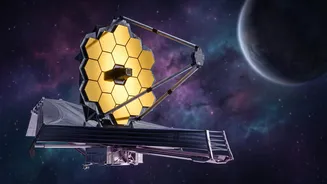
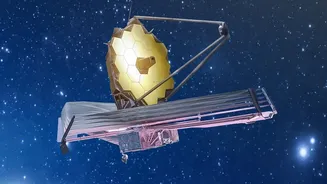
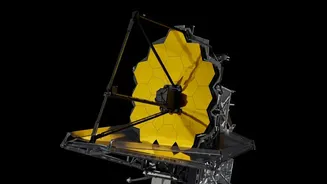
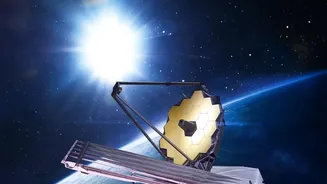
Detecting elements from light-years away is a monumental feat of technology. The JWST doesn't take a direct picture of water on a planet. Instead, it uses a technique called transmission spectroscopy. When an exoplanet passes in front of its host star from our perspective, a tiny fraction of the starlight filters through the planet's atmosphere. Molecules in that atmosphere, like water vapour (H2O), absorb very specific wavelengths, or colours, of light. By analysing the starlight that reaches its sensitive instruments, the telescope can identify these missing slivers of the light spectrum, creating a chemical fingerprint of the atmosphere. The MIRI (Mid-Infrared Instrument) on the Webb telescope was crucial for the PDS 70 discovery, able to resolve the faint signals of water from the dusty, chaotic environment of a planet-forming disk.
Not Just Any Planet
While the headline speaks of exoplanets, the type of world matters immensely. Previously, water vapour has been detected in the atmospheres of 'hot Jupiters'—massive gas giants orbiting extremely close to their stars, like WASP-39 b and WASP-107b. While these findings were groundbreaking and proved the technology worked, these planets are completely inhospitable. The ultimate goal is to find water on smaller, rocky, Earth-sized planets located in the 'habitable zone'—the orbital region where temperatures could allow liquid water to exist on the surface. The recent detection of water vapour in the terrestrial-planet-forming zone of PDS 70 is a critical step in that direction, suggesting the building blocks for habitable worlds are common.
The Search Continues
The discovery at PDS 70 is part of a much larger scientific mission. The James Webb Space Telescope is systematically studying a wide range of exoplanets and their birth environments. This includes famous systems like TRAPPIST-1, which hosts seven Earth-sized worlds, several of which are prime targets in the search for atmospheres and biosignatures. Each new detection of water, whether in the atmosphere of a gas giant or a protoplanetary disk, refines our understanding of how planetary systems form and evolve. Scientists can now compare the chemical makeup of different worlds, helping them piece together the story of why some planets become gas giants, some become barren rocks, and some, just maybe, become second Earths.