
How old is the universe? For decades, the answer has been a comforting 13.8 billion years. But a persistent debate among astronomers and new findings from a Canadian researcher are now challenging that fundamental number in a profound way.
The Universe's Two Conflicting Clocks
Understanding
the current debate requires knowing how scientists tell cosmic time. There are two main methods, and they don't agree. This disagreement is known in scientific circles as the 'Hubble Tension'. The first method involves looking at the distant past, studying the Cosmic Microwave Background (CMB)—the faint afterglow of the Big Bang. Measurements of this ancient light by missions like the Planck space telescope suggest an expansion rate that results in an age of about 13.8 billion years. This has become the standard, widely accepted age of our cosmos. The second method looks at the 'local' universe, observing relatively nearby objects like pulsating stars called Cepheids and stellar explosions known as supernovae. By measuring how fast these objects are moving away from us, astronomers can calculate the current expansion rate. The problem is, this local measurement consistently suggests the universe is expanding faster than the CMB data implies. A faster expansion means a younger universe, creating a significant and stubborn discrepancy that has cosmologists wondering if our fundamental model of the universe is missing something.
A Radical New Timeline From Ottawa
Into this ongoing debate steps Rajendra Gupta, an adjunct professor of physics at the University of Ottawa. His research, gaining attention through 2025 and 2026, puts forward a startling new figure: the universe might not be 13.8 billion years old, but a staggering 26.7 billion years old. This isn't just a minor adjustment; it's a proposal that would nearly double the cosmic timeline and force a major re-evaluation of everything we think we know about cosmic history. Gupta’s work is not meant to simply offer another number but to resolve some of the biggest puzzles that have emerged in modern astronomy.
Rewriting the Rules with 'Tired Light'
Gupta’s model is a hybrid theory that revives and combines a few different ideas. Called the 'Covarying Coupling Constants plus Tired Light' (CCC+TL) model, it marries the standard expanding universe theory with two other concepts. The first is the 'tired light' hypothesis, an old idea suggesting that light loses energy as it travels across vast cosmic distances, which would make distant objects appear redder than they are. The second concept is that fundamental physical 'constants'—the unchanging numbers that underpin the laws of physics—might actually change slowly over cosmic time. By combining these ideas, Gupta reinterprets the redshift of distant galaxies as a hybrid phenomenon, caused partly by expansion and partly by light losing energy. This change fundamentally alters the calculations used to determine the universe’s age.
Solving the 'Impossible Early Galaxy' Problem
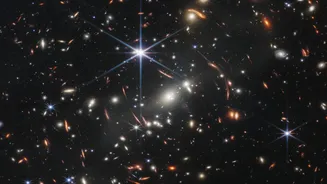
A key motivation for this new model is the 'impossible early galaxy problem'. Recent observations from the James Webb Space Telescope (JWST) have revealed galaxies in the very early universe that are shockingly mature and massive. According to the standard 13.8-billion-year timeline, these galaxies existed only a few hundred million years after the Big Bang and shouldn't have had enough time to grow so large and complex. They are like seeing a fully grown adult in a nursery. However, in a 26.7-billion-year-old universe, these galaxies would have had billions of additional years to develop, making their advanced state not just possible, but predictable. Gupta argues this extended timeline neatly resolves the mystery without requiring new physics to explain rapid galaxy formation.
A Cosmos Without Dark Matter?
The implications of the CCC+TL model go even further. For decades, the standard cosmological model has relied on the existence of two mysterious and invisible components—dark matter and dark energy—to explain the rotation of galaxies and the accelerating expansion of the universe. Together, they are thought to make up about 95% of the cosmos. Gupta's model suggests that these phenomena could instead be explained by the slow evolution of physical forces over billions of years. If proven correct, this radical alternative could eliminate the need for dark matter and dark energy altogether, solving two of the biggest mysteries in physics with one theory.