




The Sun's Hidden Danger
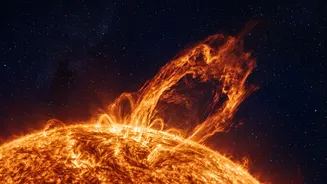
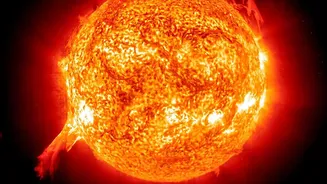
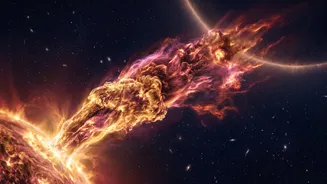
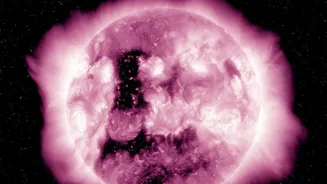
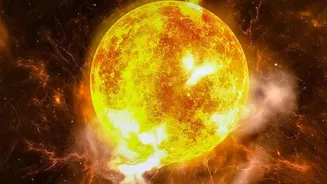
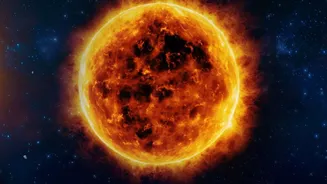
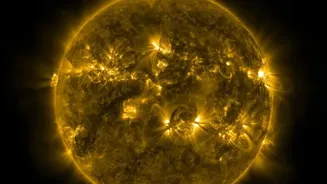
The Sun, the source of all life on Earth, also has a volatile side. It constantly sends out a stream of charged particles known as the solar wind. Occasionally, it unleashes massive eruptions of energy and plasma called coronal mass ejections (CMEs).
If Earth is in the path of a powerful CME, the resulting geomagnetic storm can be devastating. These storms can induce powerful electrical currents in our power grids, potentially causing widespread blackouts and damaging critical transformers. They can also disrupt radio communications, degrade GPS signals, and damage the sensitive electronics on which our countless satellites depend.
The Problem with 'Maybe'
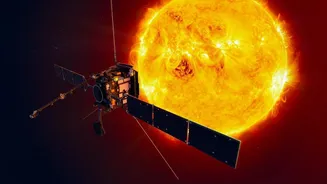
For years, space weather forecasters have been able to see a solar storm coming. Satellites can detect a CME as it leaves the Sun, giving us a day or more of warning that something is headed our way. The problem has always been a lack of precision. Knowing a storm is coming is not the same as knowing where it will hit or how severe its local impacts will be. This uncertainty makes it difficult for power companies and satellite operators to take decisive action. Do they shut down parts of the grid as a precaution, potentially causing unnecessary disruption, or risk catastrophic damage?
Enter NASA's AI Forecaster
This is where a new AI model developed with NASA is set to be a game-changer. It's called DAGGER (Deep Learning Geomagnetic Perturbation), and it tackles the 'where' problem head-on. By combining artificial intelligence with real-time data from a fleet of spacecraft, DAGGER can predict the specific locations on Earth that will be affected by a geomagnetic disturbance. It's like upgrading from a general storm warning for an entire country to a precise tornado siren for a specific town.
A 30-Minute Lifeline for Earth
DAGGER's key breakthrough is its speed and accuracy, delivering its highly specific forecasts with 30 minutes of advance warning. The AI uses a deep learning algorithm trained on vast quantities of data from past solar events. It analyzes live measurements of the solar wind—its speed, density, and magnetic field—to spot the patterns that precede a geomagnetic disturbance on the ground. While 30 minutes may not sound like much, in the world of infrastructure management, it's a critical window of opportunity. This lead time is enough for utility managers to take protective measures, for satellite operators to put their spacecraft into a safe mode, and for airlines to reroute flights away from areas where communications could be affected.
Why It Matters for a Digital India
In a nation as technologically integrated as India, the stakes are incredibly high. The entire Digital India initiative—from the UPI payment system that handles billions of transactions to the vast mobile networks that connect a billion people—relies on stable power and functioning satellites. A severe solar storm could jeopardise this delicate infrastructure. Precise warnings from a system like DAGGER would be invaluable, providing the crucial time needed to protect the digital backbone of the nation's economy. As one of the lead authors on the research for the DAGGER model, Vishal Upendran of India's Inter-University Center for Astronomy and Astrophysics, noted, this AI makes it possible to prevent devastation to modern society.