
The Challenge of a Distant Storm
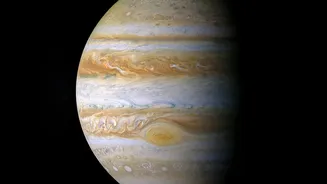
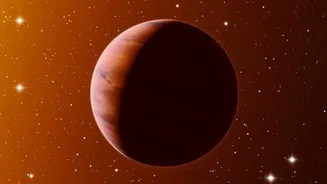
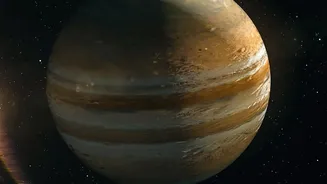
Measuring wind on other planets isn't as simple as putting up a weather vane. These worlds, like Jupiter and Saturn, are unimaginably distant and lack a solid surface to provide a stationary reference point. For decades, the most reliable method was to track
the movement of visible cloud features over time. By taking images at set intervals, astronomers could calculate how far a specific storm or cloud band had travelled. This technique, pioneered by missions like Voyager, gave us our first real sense of the ferocious atmospheric speeds on these planets. However, this method has its limits. It only works if there are clear, stable features to track, and it primarily measures horizontal wind, offering little insight into vertical motion or what happens below the visible cloud tops.
Seeing the Invisible with Infrared
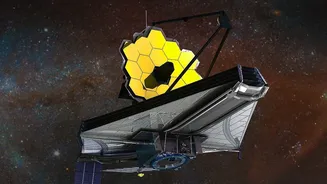
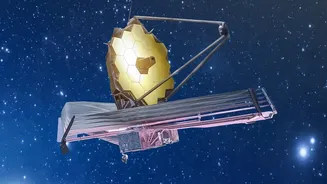
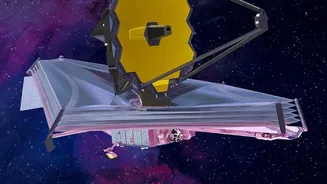
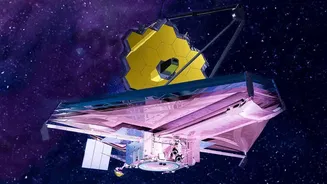
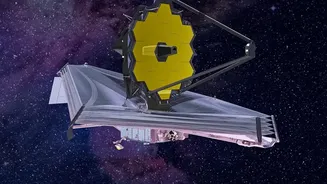
This is where infrared space optics, particularly instruments on the James Webb Space Telescope (JWST), have revolutionised the field. Gas giants are shrouded in thick layers of clouds and haze. While these layers obscure our view in visible light, infrared light can penetrate deeper. By observing in infrared, astronomers can see different layers of the atmosphere, allowing them to measure wind speeds at various altitudes. Infrared light detects heat, and the temperature differences between atmospheric layers create different patterns of light. Furthermore, specific molecules in the atmosphere, like methane or ammonia, absorb and emit light at unique infrared wavelengths. This provides a chemical fingerprint that astronomers can lock onto.
The Doppler Effect in Space
The core technique for measuring wind speed directly is spectroscopy, combined with a principle you experience every day: the Doppler effect. Just as the pitch of an ambulance siren changes as it moves towards or away from you, the frequency (or colour) of light changes based on the movement of its source. As a planet rotates, one side of its atmosphere moves towards us while the other moves away. Gas and particles swept along by winds add to this motion. By pointing a spectrograph at the planet, astronomers can analyse the light from its atmosphere. When gas is moving towards the telescope, its light shifts to a slightly shorter, bluer wavelength (a blueshift). When it moves away, the light shifts to a longer, redder wavelength (a redshift).
Decoding the Supersonic Jets
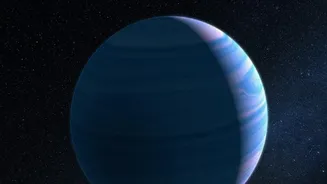
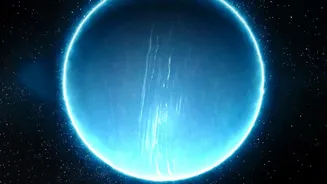
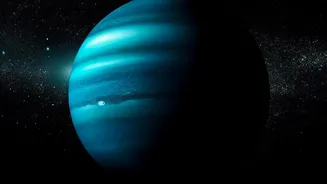
Advanced spectrographs on telescopes like the JWST can isolate the specific infrared signatures of molecules like carbon monoxide or water. By measuring the precise Doppler shift of these signatures from different parts of the planet, scientists can create a detailed velocity map. They first subtract the planet's overall rotational speed, which can be determined from its magnetic field and radio emissions. What remains is the speed of the wind itself. This method has been used to confirm incredible wind speeds, such as those on Neptune that exceed 1,800 kilometres per hour, and even discover entirely new phenomena. Recently, the JWST identified a previously unknown jet stream in Jupiter’s lower stratosphere, roaring at over 500 km/h, about 40 kilometres above the visible cloud tops. These findings are crucial for understanding the immense energy that drives these planetary weather systems, likely from the planets' hot interiors rather than the Sun.