



The New Digital Red Pen
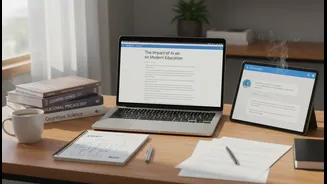
For decades, proofreading meant relying on a friend or the basic spell checker in a word processor. Those days are fading fast. Modern students now have access to a powerful suite of AI-driven writing assistants like Grammarly, ProWritingAid, and QuillBot.
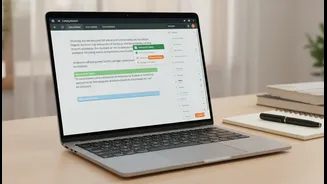
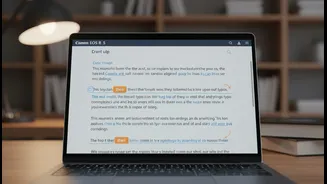
These are not your old rule-based grammar checkers that only caught simple mistakes. Powered by natural language processing (NLP) and machine learning, these tools analyze text in a way that mimics human understanding. They've been trained on billions of sentences from books, articles, and websites, allowing them to understand context, sentence structure, and style far beyond basic spelling and grammar. For a student writing a paper, this translates to real-time feedback that goes beyond simple error flagging; it's like having a personal editor available 24/7.
Catching the Uncatchable
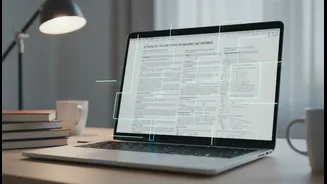
The real advantage of these AI tools lies in their ability to spot the subtle errors that even diligent human proofreaders can miss after reading a document multiple times. These platforms excel at identifying inconsistencies that the tired eye skips over. This includes catching repeated words, fixing comma splices, highlighting the overuse of passive voice, and ensuring subject-verb agreement in complex sentences. They can also detect tricky contextual spelling errors, like using 'their' instead of 'there', with high accuracy. Furthermore, AI is adept at maintaining consistency, ensuring uniform formatting and style—such as the use of the Oxford comma—throughout a lengthy document, a task where human focus can often wane. This frees up students to concentrate on the bigger picture: the strength of their argument and the clarity of their ideas.
A Tool for Learning, Not Just Correcting
Many students and educators are embracing these tools not just for correction, but as a genuine learning aid. AI assistants can do more than just fix a mistake; they often explain why something is an error, reinforcing grammar rules and improving a student's writing skills over time. By providing immediate, constructive feedback, these platforms help students identify their most frequent mistakes and work on correcting them in future assignments. Some advanced tools even offer suggestions on tone, clarity, and sentence structure, helping writers make their prose more concise and readable. This transforms the act of proofreading from a final, tedious chore into an interactive learning process, where students get real-time coaching on how to improve the overall quality of their writing.
The Debate: Crutch or Catalyst?
Despite the benefits, the rise of AI in the classroom is not without controversy. A significant debate is unfolding among educators about where to draw the line. Many professors see these tools as valuable assistants, akin to using a calculator in math class, arguing that they help students submit more polished work. However, others express concern that over-reliance on AI could prevent students from developing their own internal editor—the crucial skill of being able to critically read and improve one's own work. There's a fear that students might simply accept all suggestions without understanding the reasoning, leading to cleaner but less interesting and less authentic writing. The core of the issue is whether these tools are being used to enhance learning or to bypass it entirely, a question many educational institutions are still grappling with.
Navigating the Grey Area of Academic Integrity
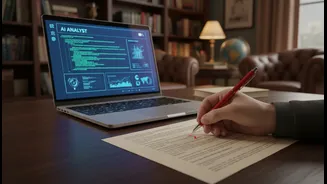
The line between a helpful editing tool and a ghostwriter is becoming increasingly blurry. While most universities permit the use of AI for basic grammar and spelling checks, using it to generate or heavily rewrite content is widely considered academic misconduct. The problem is that many tools offer both functions, and it can be tempting for a student to click 'rewrite sentence' instead of just correcting a comma. This has led to an environment where some students use 'humanizer' tools to disguise AI-generated text, while unreliable AI detectors produce false positives, making it difficult for instructors to police the boundary effectively. In response, educators are emphasizing that students should always be able to explain and defend their writing choices, regardless of what tools they used to refine them. The consensus is that AI can be a co-pilot, but the student must always remain the pilot.