


Piercing the Cosmic Veil
Imagine trying to see through a dense wall of smoke. To the naked eye, it's an impossible task. This is the challenge astronomers have faced for decades when trying to observe stellar nurseries—the vast clouds of gas and dust where stars are born. Visible
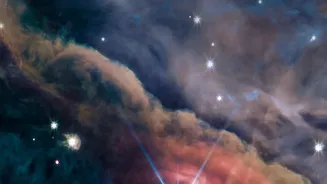
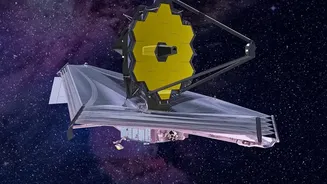
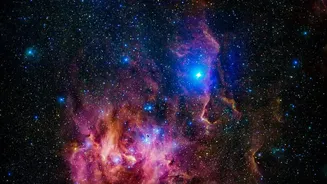
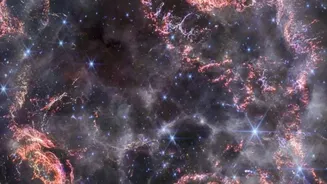
light scatters and is absorbed by the thick dust, leaving the most crucial moments of star formation completely hidden. This is where the James Webb Space Telescope's magic comes in. JWST is designed to see the universe in infrared light. Much like how infrared goggles can detect heat signatures through smoke, the telescope’s long wavelengths of light can penetrate these dense dust clouds, revealing the infant stars nestled within. What was once an opaque barrier has become a translucent window into the cosmos, allowing scientists to witness the earliest stages of star development with astonishing clarity.
A New Look at Iconic Birthplaces
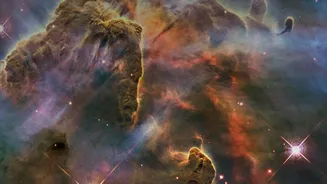
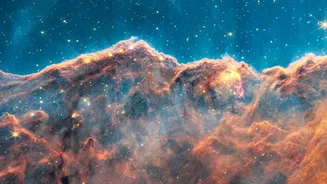
Iconic regions of space that were made famous by the Hubble Space Telescope are now being seen in a completely new light. Take the “Cosmic Cliffs” in the Carina Nebula, a landscape of gaseous mountains and valleys where star formation is rampant. While Hubble showed us the grand structure, Webb’s infrared view peers inside, uncovering dozens of previously invisible protostars and energetic jets. These jets, which are massive outflows of material ejected by young stars as they gather mass, are a critical part of the star formation process. Webb’s ability to capture these features in high resolution helps confirm theories about how stars regulate their own growth. By comparing new Webb images to older Hubble data, astronomers can even track the movement of these jets over time, gaining unprecedented insight into the dynamics of these stellar nurseries.
The Surprise of Protostellar Jets
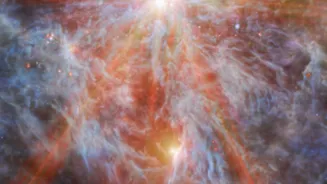
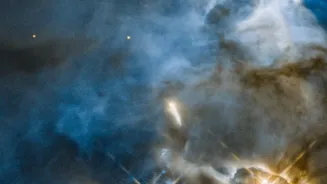
One of the most exciting revelations from JWST is the incredible detail of protostellar jets. These are powerful streams of gas and material fired out from the poles of a baby star as it accretes matter from its surrounding disk. For a long time, these jets were mostly theoretical or observed with limited clarity. Webb, however, has captured them in stunning detail, showing them as complex, wiggling structures that extend for light-years. In some cases, the symmetry of these jets provides clear evidence of how the young star is spinning and interacting with its environment. Recent observations of a massive protostar named S284p1 revealed jets spanning roughly eight light-years, showing that the scale of these outflows is directly related to the mass of the forming star—a key insight into how the biggest stars in the universe take shape.
From Cosmic Engines to Chemical Labs
JWST’s observations go far beyond just taking beautiful pictures; they are transforming stellar nurseries into giant laboratories. The telescope’s instruments can analyze the chemical composition of the gas and dust, identifying the building blocks of stars and planets. Webb has detected water ice, hydrocarbons, and complex organic molecules in the clouds where stars are just beginning to form. It can distinguish between different types of winds blowing gas away from a young star's planet-forming disk—some driven by magnetic fields and others by the star's intense radiation. Understanding this process is crucial, as planet formation is a race against time; planets must form before these winds clear out all the raw material. In some of the most active star-forming regions, like Sagittarius B2 near our galaxy's center, Webb is helping scientists understand why some nurseries are so much more productive than others.