


They are two of the sky’s most spectacular shows, but it’s easy to mix them up. Both solar and lunar eclipses involve the Sun, Moon, and Earth in a cosmic lineup, but the story changes completely depending on who is casting the shadow.
The Solar Eclipse: The Moon Blocks the Sun
A solar eclipse
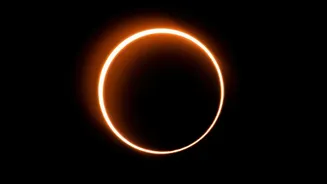
happens when the Moon passes directly between the Sun and Earth, casting a shadow on our planet. This alignment can only occur during the New Moon phase. For those within the darkest part of this shadow, known as the umbra, the sky darkens dramatically as the Moon completely blocks the Sun’s face. This is a total solar eclipse, a rare event that reveals the Sun's ethereal outer atmosphere, the corona. Outside of this narrow path of totality, observers see a partial solar eclipse, where the Moon only obscures part of the Sun. There is also an annular eclipse, which happens when the Moon is farther from Earth in its orbit and appears too small to completely cover the Sun, leaving a brilliant 'ring of fire' visible.
The Lunar Eclipse: The Earth Blocks the Moon
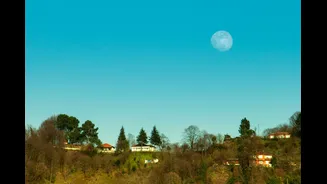
A lunar eclipse occurs when the Earth passes directly between the Sun and the Moon, casting its own shadow over the lunar surface. This can only happen during a Full Moon, when the Moon is on the opposite side of Earth from the Sun. Unlike a solar eclipse, which is visible from only a small area, a lunar eclipse can be seen by anyone on the night side of Earth. There are three types. A total lunar eclipse happens when the entire Moon passes through Earth's umbra, its darkest shadow. During this phase, the Moon often takes on a reddish glow, sometimes called a 'Blood Moon', because some sunlight is filtered and bent through Earth's atmosphere onto the Moon. A partial lunar eclipse occurs when only part of the Moon enters the umbra, while a penumbral eclipse is a subtle dimming as the Moon passes through Earth's fainter outer shadow.
Key Difference: Who Sees It?
Perhaps the biggest practical difference between the two events is their visibility. A total solar eclipse is a localized event. The Moon's shadow on Earth is relatively small, creating a narrow path of totality, often only about 160 kilometres wide. To see one, you must be physically inside this path. A lunar eclipse, however, is a much more widely viewed event. Because it is the entire Moon that is falling into Earth's much larger shadow, anyone on the planet's night side with a clear view of the Moon can watch the entire event unfold. This is why it feels like lunar eclipses are far more common; for any given location, you are much more likely to witness a lunar eclipse than a total solar eclipse.
Key Difference: How to Watch Safely
Safety is the most critical distinction. You must never look directly at the Sun during a solar eclipse without proper eye protection. Even when 99% of the Sun is covered, the remaining sliver is intensely bright and can cause permanent eye damage. Certified eclipse glasses or a special-purpose solar filter are mandatory. The only exception is during the brief moments of totality in a total solar eclipse, when the Sun's face is completely blocked. In stark contrast, a lunar eclipse is perfectly safe to view with the naked eye. Since you are looking at the Moon as it is being darkened by Earth's shadow, there is no intense light to harm your vision. You can enjoy the show from start to finish without any special equipment.