





A Pathfinder for Lunar Ambitions
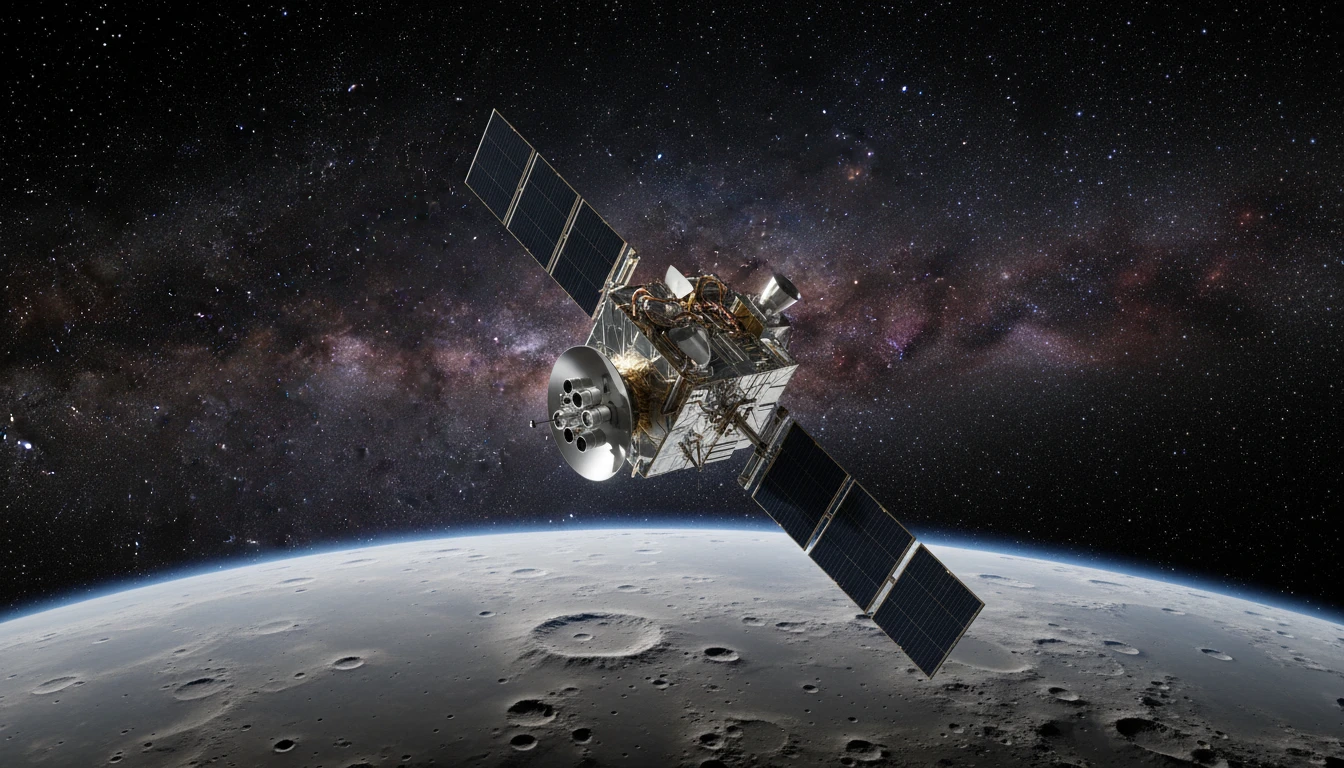
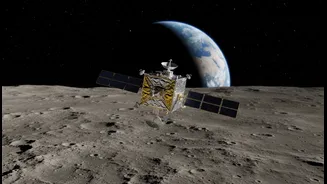
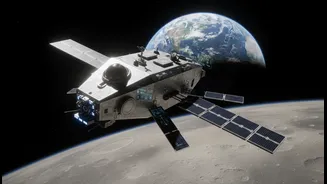
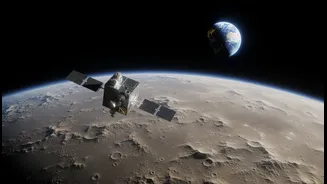
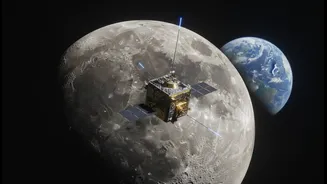
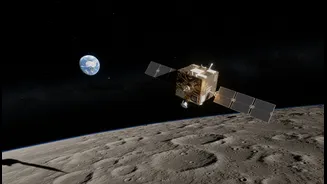
Launched in June 2022, the Cislunar Autonomous Positioning System Technology Operations and Navigation Experiment, or CAPSTONE, is a small but mighty CubeSat with a crucial job. Its primary goal has been to serve as a trailblazer for NASA's Artemis program,
which aims to establish a long-term human presence on and around the Moon. Owned and operated by Colorado-based Advanced Space for NASA, the 55-pound spacecraft was designed as a low-cost way to reduce risks for future, more complex missions. By flying a new, unproven path and testing innovative technologies, CAPSTONE provides critical real-world data, transforming theoretical models into operational experience and paving the way for the Lunar Gateway, a future space station in orbit around the Moon.
The Revolutionary 'Halo' Orbit
At the heart of CAPSTONE's mission is the Near-Rectilinear Halo Orbit (NRHO). This highly elliptical orbit is unlike the low, circular paths of the Apollo era. Instead, it positions a spacecraft in a gravitational sweet spot, balanced between the Earth and the Moon. This unique trajectory offers remarkable stability, requiring minimal fuel to maintain, which is ideal for a long-term outpost like the Gateway, planned for a 15-year mission. The orbit brings the spacecraft as close as 1,600 kilometers to one lunar pole and as far as 70,000 kilometers from the other. This provides efficient access to the lunar surface, particularly the resource-rich South Pole, while also ensuring a continuous line-of-sight to Earth for uninterrupted communication—a combination that other orbits cannot offer. CAPSTONE was the first spacecraft to ever fly in an NRHO, successfully validating its stability and characteristics.
Navigating a New Frontier, Autonomously
Beyond testing the orbit itself, CAPSTONE's other major goal was to demonstrate revolutionary navigation technology. The Cislunar Autonomous Positioning System (CAPS) is designed to allow spacecraft to determine their position without relying on constant instructions from ground stations on Earth. To do this, CAPSTONE has been communicating directly with NASA's Lunar Reconnaissance Orbiter (LRO), which has been circling the Moon since 2009. By measuring its position relative to LRO, CAPSTONE demonstrated a form of peer-to-peer navigation. During its extended mission, it also tested software that used optical navigation—taking images of the Moon and Earth to determine its location. This capability is essential for a future where the cislunar space is bustling with activity, reducing the burden on Earth-based deep space networks and enabling more resilient and independent operations.
Proving the Path for the Gateway
Every success of the CAPSTONE mission directly informs and de-risks the ambitious Lunar Gateway project. The Gateway is envisioned as a command center, science lab, and habitat that will orbit the Moon, serving as a staging point for missions to the lunar surface and, eventually, Mars. By proving the NRHO is stable and requires little fuel for station-keeping, CAPSTONE has confirmed that the Gateway can stay in its intended orbit for many years. Furthermore, its autonomous navigation experiments provide the foundation for how the Gateway and other visiting spacecraft will manage their trajectories and dockings. The operational data gathered on propulsion requirements, communications reliability, and maneuver strategies provide an invaluable playbook for Gateway's flight controllers and future mission planners.
The Legacy of a Shoebox-Sized Explorer
After successfully completing its primary and extended mission objectives by mid-2026, NASA's official activities on CAPSTONE concluded. However, its work isn't done. The spacecraft continues to operate, serving as an in-orbit testbed for new technologies. The mission demonstrated that a small, relatively inexpensive commercial spacecraft can achieve historic firsts and provide mission-critical data for a multi-billion-dollar international exploration program. It showcased how new software could be uploaded after launch, turning an operational spacecraft into a flexible testing platform. For engineers and space professionals, CAPSTONE is a case study in efficiency and ingenuity, proving that sometimes the biggest leaps forward in space exploration are made by the smallest pioneers.