






The Unseen Cosmic Engines
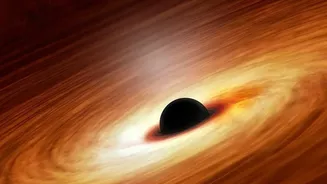
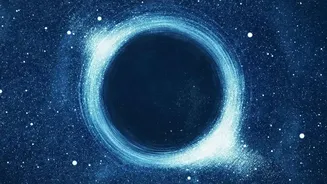
At the heart of most large galaxies, including our own Milky Way, lurks a supermassive black hole. When these giants are actively feeding on surrounding gas, dust, and stars, they become what astronomers call an Active Galactic Nucleus (AGN). This process
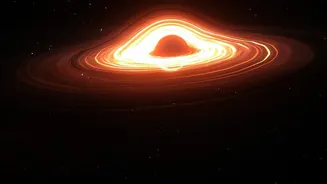
of 'accretion' is incredibly violent and energetic. As material spirals inward, it forms a disc that heats up to millions of degrees, releasing enormous amounts of radiation that can outshine the entire host galaxy. This makes them visible across billions of light-years. However, directly observing the immediate environment of a black hole is incredibly difficult, not just because of the mind-boggling distance but also because the central engine is often shrouded by a dense, doughnut-shaped torus of gas and dust. For a long time, our understanding was based on static snapshots and theoretical models.
A Decade-Long Vigil
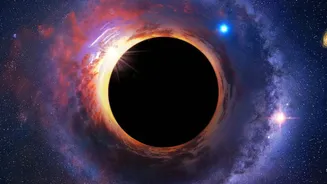
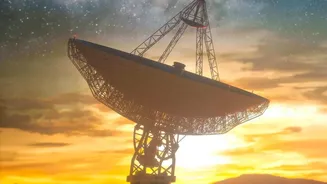
Capturing changes in something so distant and massive requires patience and immense technological power. The breakthrough came from a decade-long effort combining observations from multiple high-powered telescopes. By using techniques like Very Long Baseline Interferometry (VLBI), astronomers can link radio telescopes across the globe to function as a single, Earth-sized virtual observatory, famously achieved by the Event Horizon Telescope (EHT) collaboration. This incredible resolution allows them to peer into the turbulent regions near the black hole's event horizon—the point of no return. Over several years, researchers have collected data from these cosmic behemoths, looking for subtle shifts that might indicate the structures are not as fixed as once believed. The goal was to move beyond a single photograph and create something more like a movie.
What is Actually Changing?
The long-term study revealed crucial structural shifts in two key areas: the corona and the base of the relativistic jets. The corona is a region of incredibly hot, X-ray-emitting plasma surrounding the black hole. Previously, its exact shape was a matter of debate. New data reveals that the corona is not a uniform sphere but is extended along the same plane as the accretion disk, like a glowing haze. Studies have tracked this corona evolving, sometimes growing more distant from the black hole just before it launches powerful jets of matter. These jets are colossal outflows of energy and particles travelling at near-light speed. The connection between the shifting corona and the launching of these jets suggests a deep, dynamic relationship between how a black hole feeds and how it ejects energy back into its galaxy.
The Technique: From X-rays to Radio Waves
Observing these changes required a multi-wavelength approach. Astronomers can’t 'see' a black hole directly, so they study its effects on nearby matter. X-ray telescopes like NASA's IXPE (Imaging X-ray Polarimetry Explorer) were crucial for mapping the corona. By analyzing the polarization of X-rays—the orientation of the light waves—scientists could finally determine the corona's shape and its link to the accretion disk. This data was complemented by radio observations from telescope arrays like the EHT and ALMA, which can detect the powerful magnetic fields spiraling around the black hole's edge and trace the jets they launch. By comparing observations from different years, researchers could piece together a timeline of change, revealing a cosmic engine in constant flux rather than a static object.
Rewriting the Black Hole Playbook
These findings are about more than just seeing a black hole wobble. They fundamentally alter our understanding of how galaxies evolve. The energy and matter fired out by a black hole's jets can regulate star formation across its host galaxy, sometimes triggering it and other times quenching it. Proving that the structures around black holes are dynamic and change over observable timescales provides a crucial missing link. It confirms that the way a black hole 'eats' is directly tied to the powerful feedback it sends into the cosmos. This challenges older, simpler models and provides vital data for creating more accurate simulations of how the universe came to look the way it does today. The research shows that even the most massive objects in the universe are not static monuments, but living, breathing parts of the cosmic ecosystem.