






What's In A Name?
First, let’s break down that name: 3I/ATLAS. It’s not just a random jumble of characters; it’s a condensed history of the object. The '3I' tells you it's the third interstellar object ever confirmed. The 'I' stands for interstellar, a designation reserved
for objects that are not gravitationally bound to our Sun and are just passing through. The 'ATLAS' part of its name comes from the survey that discovered it—the Asteroid Terrestrial-impact Last Alert System. This NASA-funded network of telescopes scans the sky every night, primarily looking for asteroids that could pose a threat to Earth, but its constant vigilance also helps it spot rare visitors like this one. Discovered on July 1, 2025, 3I/ATLAS was quickly identified as something special because of its trajectory and immense speed.
A Messenger From Far Away
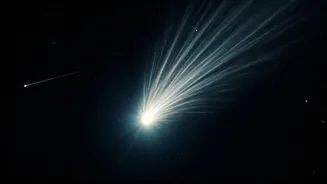
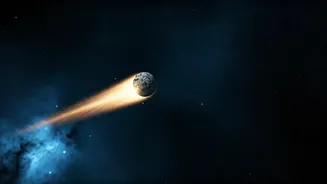
When we say 'interstellar,' we mean it. This isn't a comet from the Kuiper Belt or the Oort Cloud, the distant icy reservoirs of our own solar system. 3I/ATLAS originated from a completely different star system. Tracing its path backward, astronomers believe it came from the direction of the constellation Sagittarius. Like its predecessors—1I/'Oumuamua, discovered in 2017, and 2I/Borisov, found in 2019—3I/ATLAS is a precious sample of material from another corner of the galaxy. 'Oumuamua was a bizarre, elongated object that didn't behave like a typical comet. Borisov, on the other hand, looked and acted much like the comets we know, with a clear coma and tail. 3I/ATLAS appears to be more in the Borisov camp, showing clear signs of cometary activity, with gas and dust creating a shroud around its icy nucleus.
A Rare Opportunity for Science
The discovery of an interstellar object is a major event because it’s a freebie from the cosmos. It gives scientists a chance to study the building blocks of another planetary system without having to launch a multi-billion dollar, multi-generational mission to another star. By analyzing the light reflected off 3I/ATLAS and the gases it emits as it gets closer to our Sun, researchers can determine its chemical composition. Early studies have already yielded fascinating results, including the detection of nickel vapor in its coma, which is unusual at such a great distance from the Sun. The comet is on a hyperbolic trajectory, meaning it's moving too fast to be captured by the Sun's gravity. It's like a cosmic slingshot, using our star for a gravitational assist on its endless journey through the void.
What Happens Next?
So, can you see it? Unfortunately, 3I/ATLAS will not be a naked-eye object. Its path keeps it quite far from Earth. Its closest approach to the Sun, known as perihelion, occurred around October 30, 2025, at a distance just inside the orbit of Mars. During that time, it was on the opposite side of the Sun from Earth, making it impossible to see from here. However, an armada of space-based telescopes and probes, including the Hubble Space Telescope and even spacecraft near Jupiter like the Lucy mission, have been trained on it to gather as much data as possible before it slips away forever. These observations are crucial, providing data on the comet's size, rotation, and composition, helping us understand if the ingredients for planets are the same in other star systems as they are in ours.