






A Pit Stop With a Purpose
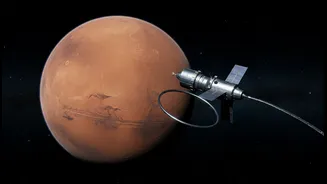
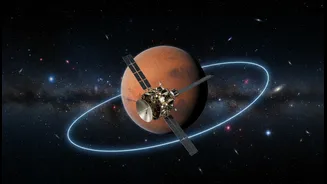
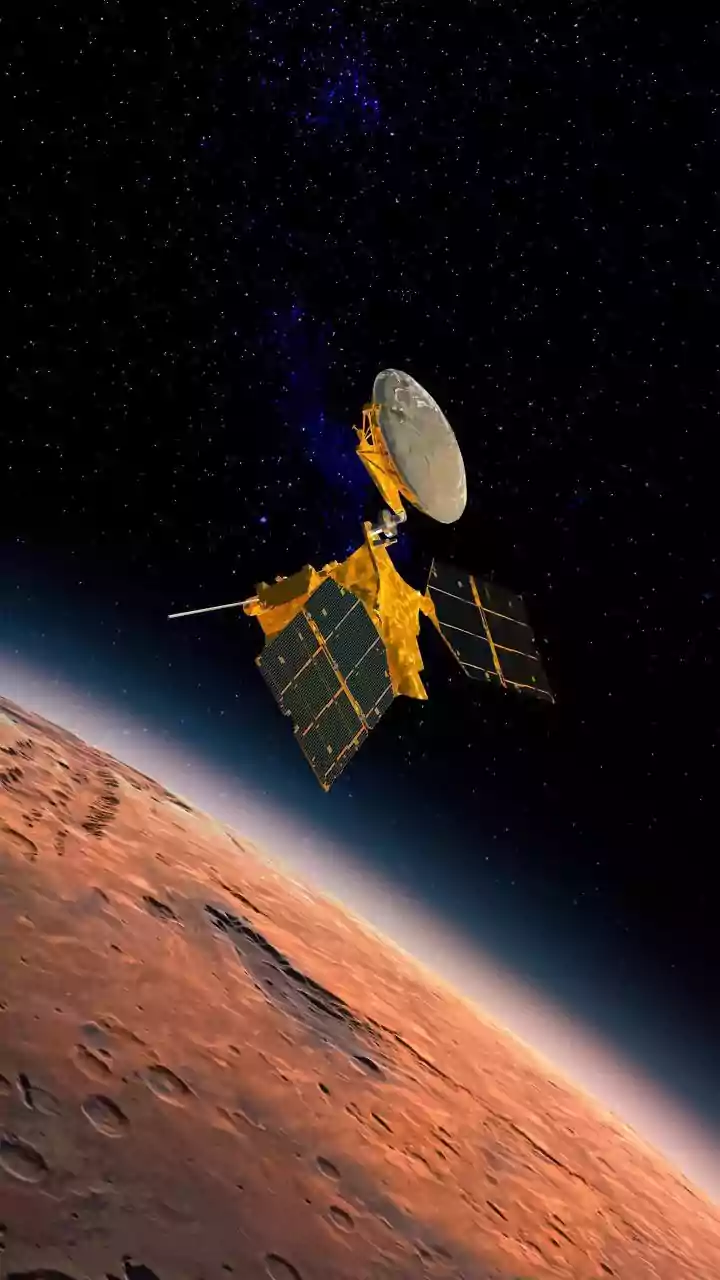
On May 15, 2026, the Psyche spacecraft flew within 2,864 miles of the Martian surface, but this was no sightseeing trip. The close approach was a precisely calculated maneuver known as a gravity assist. By dipping into Mars's gravitational well, the spacecraft “stole”
a small amount of the planet's orbital energy. This cosmic slingshot boosted Psyche’s speed by about 1,000 miles per hour and adjusted its trajectory, all without burning its own precious propellant. This fuel-saving technique is essential for long-haul interplanetary missions, making an ambitious journey like this one possible. The flyby also served as a dress rehearsal, allowing the mission team to calibrate its science instruments by taking stunning, high-resolution images of Mars as it sped past.
The Main Event: Asteroid 16 Psyche
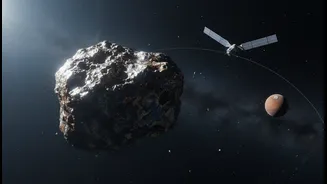
The true destination of this multi-year, billion-mile journey lies in the main asteroid belt between Mars and Jupiter. It's a massive, potato-shaped object known as 16 Psyche, roughly 173 miles across at its widest point. Discovered in 1852, Psyche is unlike any world humanity has visited before. While most asteroids are rocky or icy, radar and telescopic observations suggest Psyche is extraordinarily rich in metal. This makes it the first mission of its kind, venturing to a world that isn't made of rock or ice, but of the very materials found deep inside planets like our own.
A Window Into Planetary Cores
So why travel all that way for a metal asteroid? Scientists are thrilled because they believe 16 Psyche could be the exposed nickel-iron core of a protoplanet—a small, would-be planet from the early days of our solar system. Billions of years ago, this protoplanet may have been struck by other objects in a series of violent, hit-and-run collisions that stripped away its rocky outer layers, leaving its metallic heart exposed. Since we can never access Earth's own core due to immense heat and pressure, visiting Psyche is the next best thing. It offers a unique, direct look at the building blocks of planets, providing clues about how terrestrial worlds like Earth formed and what lies at their inaccessible centers.
The Tech Behind the Trek
Getting to Psyche is a monumental challenge that requires groundbreaking technology. Launched aboard a SpaceX Falcon Heavy rocket on October 13, 2023, the spacecraft itself is a marvel of engineering. It is primarily propelled by a futuristic solar electric propulsion system. Huge solar arrays, large enough to fill a tennis court, capture sunlight and convert it into electricity. This power is then used to run Hall-effect thrusters, which expel charged atoms of xenon gas to create a gentle but highly efficient and constant thrust. This technology, while providing acceleration equivalent to the weight of a few coins in your hand, allows the spacecraft to build up incredible speeds over its long journey. The mission also tested Deep Space Optical Communications (DSOC), a laser-based system that can transmit data at much higher rates than traditional radio-based systems.
The Long Road Ahead
With the successful Mars flyby now in its rearview mirror, Psyche's long and lonely cruise continues. The spacecraft will spend the next few years traveling through deep space, its ion thrusters firing for long stretches to continue its acceleration toward the asteroid belt. It is scheduled to arrive at asteroid 16 Psyche in August 2029. Upon arrival, it won't land but will instead enter a series of orbits around the asteroid, getting progressively closer over a 26-month science campaign. From these vantage points, its suite of instruments—including multispectral imagers, gamma-ray and neutron spectrometers, and magnetometers—will map the surface, determine its composition, and probe for any lingering magnetic field, painting the first complete picture of this mysterious metal world.