







It's one of the most predictable events in our daily lives: the sun rises in the east and sets in the west. But the sun isn't actually moving across our sky. The secret lies in a cosmic dance where our own planet is the lead performer.
It’s All About the Spin
The simple answer
is that the sun appears to rise in the east because the Earth rotates, or spins, towards the east. Imagine standing still and watching the world go by from a merry-go-round; the scenery appears to move, but it's you who is turning. The same principle applies to our planet. The sun remains fixed at the center of our solar system, while the Earth makes one complete turn on its axis every 24 hours. This eastward spin is what creates the illusion of the sun, moon, and stars traveling westward across our sky. As the part of the Earth you are standing on turns to face the sun, it appears over the eastern horizon—an event we call sunrise.
A Counter-Clockwise Journey
To be more specific, if you were to look down on Earth from above the North Pole, you would see it spinning in a counter-clockwise direction. This motion is known in astronomy as 'prograde' rotation, which is the same direction that most planets in our solar system spin and orbit the sun. Because we are on the surface of this counter-clockwise spinning sphere, our perspective makes the sun appear to move in the opposite direction. Think of it like walking forward on a train; to someone sitting still, you are moving forward, but the scenery outside is zipping backward. Our eastward rotation at speeds of up to 1,600 kilometers per hour at the equator carries us continuously toward the sunrise.
Does It Rise Exactly in the East?
Here’s where it gets more interesting. The sun only rises 'due east' on two specific days of the year: the spring and autumn equinoxes (around March 21 and September 22). On all other days, the sunrise position shifts. This is because Earth’s axis is tilted by about 23.5 degrees relative to its orbit around the sun. During the summer in the Northern Hemisphere, the North Pole is tilted towards the sun, causing the sun to rise in the northeast and set in the northwest. Conversely, during the winter, the North Pole is tilted away from the sun, so the sun rises in the southeast and sets in the southwest. This axial tilt is also the reason we have seasons.
Is Earth’s Sunrise Universal?
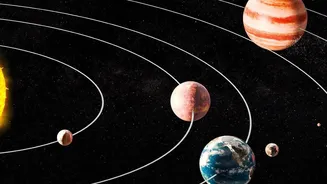
While an eastern sunrise is the norm for us, it’s not a universal rule in the solar system. Most planets have a prograde (counter-clockwise) rotation like Earth, but there are a couple of fascinating exceptions. Venus, for example, has a 'retrograde' or backward rotation. This means it spins clockwise, so if you could stand on its scorching surface, you would see the sun rise in the west and set in the east. Uranus is another oddball; it's tilted so far over that it essentially spins on its side. These exceptions, likely caused by massive impacts deep in the planets' pasts, are a great reminder that the familiar rhythm of our own world is a product of its unique cosmic history.