





1. Gaganyaan: India's Giant Leap for Humankind
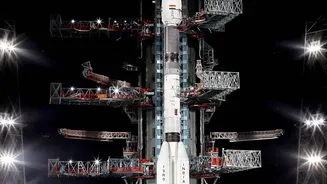
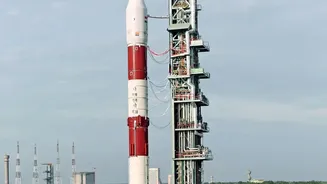
The Gaganyaan programme is undoubtedly ISRO's most awaited endeavour, aiming to demonstrate human spaceflight capability by launching a crew of astronauts into an orbit of 400 km for a three-day mission. After several uncrewed test flights, including
one with a humanoid robot named Vyommitra, the first crewed flight is anticipated around 2027. This mission is not just about sending Indians to space; it's about developing critical technologies for life support, re-entry, and crew escape systems, laying the foundation for a sustained human presence in space. Successful execution will make India the fourth nation in the world to independently send humans into orbit.
2. Bharatiya Antariksha Station: An Indian Address in Orbit
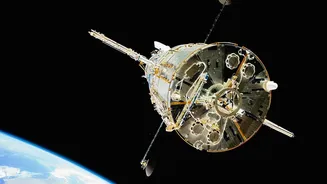
Following Gaganyaan, ISRO plans to establish India's own space station, the Bharatiya Antariksha Station (BAS), by 2035. This modular station will be placed in a Low Earth Orbit at an altitude of about 400-450 kilometres. The first module is targeted for a 2028 launch. Designed to host astronauts for long-duration stays of three to six months, the BAS will serve as a microgravity laboratory for advanced scientific research in fields like biotechnology and materials science. It signifies a monumental step from short-term missions to a continuous, long-term presence in space.
3. Mangalyaan-2: A Bold Return to the Red Planet
Building on the phenomenal success of its first Mars Orbiter Mission (MOM), ISRO is planning a far more ambitious sequel. Mangalyaan-2 aims not just to orbit Mars, but to land on it. The mission, which could launch as early as 2028 or 2030, is expected to include a lander, a rover, and even a helicopter, similar to NASA's Ingenuity. This would make India only the third country to successfully operate a spacecraft on the Martian surface. The objectives include studying the Martian surface, atmosphere, and environmental conditions to better understand the planet's history and potential for past life.
4. Shukrayaan-1: Unveiling the Secrets of Venus
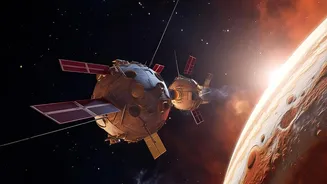
Next on the interplanetary agenda is Venus, Earth's mysterious twin. The Shukrayaan-1 mission, India's first to the planet, will see an orbiter dispatched to study its scorching surface and toxic atmosphere. Formally approved in 2024, the launch is scheduled for March 2028. The spacecraft will carry a suite of instruments to map the surface and subsurface, investigate the atmospheric chemistry, and understand why Venus evolved so differently from Earth despite its similar size. This mission will provide a wealth of data about one of the solar system's most intriguing and least-explored planets.
5. LUPEX: Exploring the Moon's Water Ice
The Lunar Polar Exploration Mission (LUPEX) is a joint venture between ISRO and the Japan Aerospace Exploration Agency (JAXA), planned for no earlier than 2028. This collaborative mission will explore the Moon's south pole, a region believed to hold significant deposits of water ice. For LUPEX, ISRO is responsible for developing the lander that will safely deliver a Japanese-built rover to the lunar surface. The rover will then investigate the quantity and quality of water, a resource crucial for future sustainable activities on the Moon, including supporting a permanent human presence.
6. NISAR: A High-Tech Eye on Planet Earth
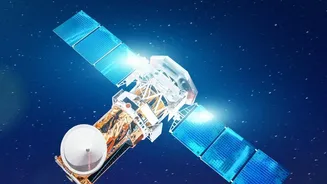
A landmark collaboration between NASA and ISRO, the NISAR (NASA-ISRO Synthetic Aperture Radar) satellite is the world's most expensive Earth-imaging satellite. Launched in July 2025, its mission is to track changes on Earth's surface with unprecedented detail. Using dual-frequency radar, NISAR can see through clouds and darkness to monitor subtle movements of land and ice, providing crucial data for managing natural disasters like earthquakes and landslides, tracking climate change effects on glaciers, and monitoring agricultural resources. The satellite will scan nearly all of Earth’s land and ice surfaces every 12 days.
7. Reusable Launch Vehicle (RLV): The Future of Low-Cost Launches
To make space access more affordable, ISRO is developing its own reusable launch vehicle technology. The RLV-TD (Technology Demonstrator) programme has been conducting a series of tests to master autonomous landing and hypersonic flight. These winged vehicles, like a space plane, are designed to fly back to Earth and land on a runway after deploying their payload, allowing them to be reused for future missions. While still in the experimental phase, the successful completion of the Orbital Re-entry Experiment (ORE) will be the final step, paving the way for a fully operational, two-stage reusable rocket that could drastically reduce the cost of launches.