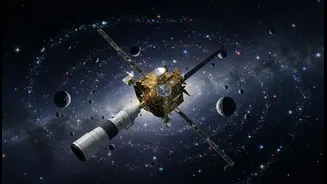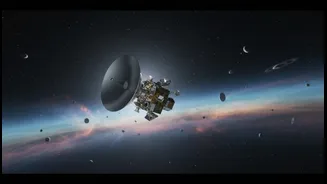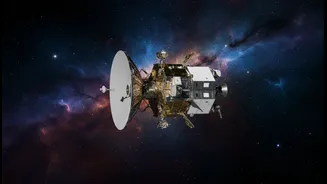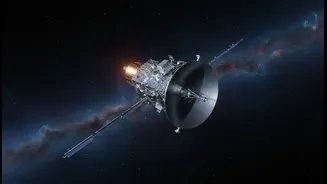



A Journey Beyond Planets
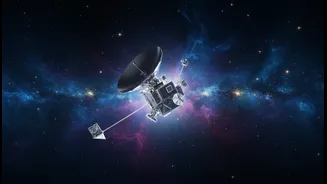
Launched in 2006, New Horizons is one of humanity's most accomplished explorers. It holds the record for the fastest spacecraft ever launched from Earth and gave us our first breathtaking, close-up views of Pluto in 2015. Four years later, it went even
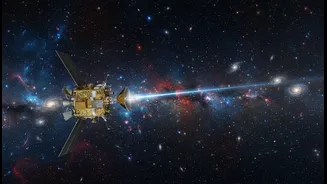
deeper, flying past Arrokoth, the most distant object ever visited by a spacecraft. Its primary mission was to understand the worlds at the edge of our solar system. Having achieved that, the probe is now being repurposed. Instead of being a planetary geologist, it's becoming a deep-space observatory, using its unique position to conduct science that is impossible from anywhere else.
Waking Up for a New Mission
On June 23, 2026, after a 321-day slumber to conserve resources, New Horizons successfully executed stored commands to wake itself up. Mission operators at the Johns Hopkins Applied Physics Laboratory confirmed the probe was in good health, a message that took nearly nine hours to travel back to Earth. This “awakening” marks the start of a new operational phase. While some instruments continued to gather data during hibernation, the full suite is now active again. In the coming weeks, its Alice ultraviolet spectrometer will begin a dedicated campaign to study the far reaches of our solar system and the mysterious light that permeates the cosmos.
The Universe's Puzzling Glow
For decades, astronomers have been vexed by a faint, uniform ultraviolet (UV) light that seems to come from every direction in space. When they add up all the known sources of UV light—distant stars, galaxies, and glowing gas—the numbers don't match. The universe is significantly brighter in the far-ultraviolet spectrum than our models predict, almost by a factor of two. This discrepancy, known as the cosmic ultraviolet background, is a major puzzle. It suggests that there's a source of UV light we haven't accounted for, a missing piece in our understanding of the cosmos. Theories range from undiscovered populations of faint galaxies to more exotic ideas like the decay of dark matter particles.
A Unique Vantage Point
Measuring this faint UV background from Earth or even near-Earth orbit is incredibly difficult. The inner solar system is filled with a bright haze of UV light, primarily sunlight scattering off interplanetary dust and hydrogen atoms. This creates a local glare that blinds us to the faint, distant signal. This is where New Horizons' location becomes its superpower. Now billions of miles past Pluto, it is flying through a much darker, cleaner region of space. It is beyond the bulk of the solar system's dust and is approaching the edge of the heliosphere, the bubble of charged particles blown by our sun. From this pristine vantage point, its Alice instrument can measure the true darkness of space and get a much clearer reading of the faint cosmic UV background.
Solving a Cosmic Mystery
The data New Horizons is now beginning to collect could finally reveal the source of the extra UV light. By pointing its spectrometer at seemingly empty patches of sky, it can measure the intensity of this background glow with unprecedented accuracy. These measurements will help astronomers determine if the glow is uniform, which might point to a cosmological origin like dark matter, or if it's patchier, perhaps indicating vast, unseen structures of hot gas in our galaxy's halo. The probe's extended mission, which will see it continue to operate until at least 2028, ensures it will keep mapping this phenomenon as it travels further into the void. This makes New Horizons not just a relic of planetary exploration, but a vital, active tool for cosmology.