




An Alien Yet Familiar World
Saturn’s largest moon, Titan, is one of the most intriguing destinations in our solar system. It is the only other body besides Earth that has a dense atmosphere and stable liquid on its surface. But this is where the similarities take an alien twist.
Titan’s landscape is sculpted not by water, but by liquid methane and ethane. It has a weather system where methane clouds gather, rain down, and fill vast lakes and seas, creating an otherworldly version of Earth’s water cycle. Despite its Earth-like geological processes, Titan is incredibly frigid, with surface temperatures around -179 degrees Celsius. This unique combination of a familiar-looking landscape and exotic chemistry makes it a top priority for scientists trying to understand the building blocks of life. The Cassini mission gave us tantalizing glimpses from orbit, but its radar couldn't definitively tell us what the surface was made of, leaving a world of mystery for a new explorer to uncover.
Meet Dragonfly: The Moon-Hopping Drone
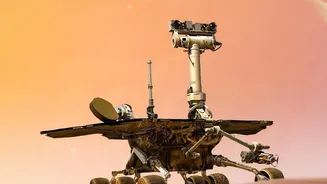
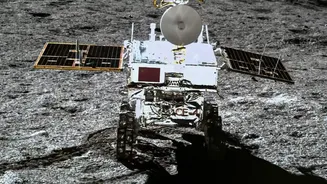
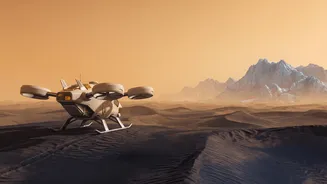
Enter Dragonfly, NASA’s ambitious mission to send a robotic rotorcraft to fly through Titan's skies. Scheduled to launch in July 2028 and arrive in 2034, Dragonfly is unlike any Mars rover. It’s a dual-quadcopter, essentially a car-sized drone, designed to take advantage of Titan’s unique environment. The moon’s atmosphere is four times denser than Earth's, and its gravity is much weaker, making flight an incredibly efficient way to explore. While a rover is limited to a small area, Dragonfly will be able to fly from one site to another, covering dozens of kilometers in a single hop. Powered by a Multi-Mission Radioisotope Thermoelectric Generator (MMRTG) — a nuclear power source that provides constant energy and heat — Dragonfly will be able to operate for years, making multiple flights to scientifically diverse locations. This mobility is key to its mission: to sample a wide variety of materials across different geologic settings.
The Mystery of the Organic Dunes
One of Dragonfly's first targets will be the vast, dark dunes that circle Titan’s equator. These are not dunes of silicate sand like those on Earth. Instead, they are composed of solid organic particles that have settled out of Titan's hazy atmosphere. What these particles are exactly is a major enigma. We know Titan's atmosphere, a mix of nitrogen and methane, is constantly being zapped by sunlight and cosmic rays, creating a complex smog of organic compounds that slowly drift down to the surface. Scientists believe these particles form the 'sand' that winds shape into dunes up to 100 meters high. Dragonfly is set to land in a dune field called Ahmakiq Undae within the Shangri-La region. There, it will use its drill to collect samples and its onboard spectrometer to analyze their composition, providing our first ground-truth data on these strange, dark sands.
A Laboratory for Life's Origins
The core of the Dragonfly mission is to investigate prebiotic chemistry—the complex chemical steps that occurred on Earth before life emerged. Titan is essentially a giant, frozen natural laboratory for this kind of chemistry. The ingredients are all there: an abundance of carbon-rich molecules, an energy source from the sun, and a dynamic environment. Dragonfly's goal isn't to find existing life, but to search for chemical biosignatures and understand how far along the path to life Titan has come. One of its prime targets after exploring the dunes is the Selk impact crater. Scientists theorize that the heat from the asteroid impact that created the crater could have melted the local water-ice bedrock for thousands of years. This would have created a temporary 'hot spot' where liquid water mixed with the rich organic materials on the surface—a perfect recipe for the kind of complex chemistry that may have sparked life on our own planet. By sampling material from this crater, Dragonfly could find evidence of how these building blocks of life behave when water enters the equation.