






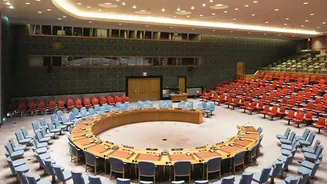
The United Nations Secretary-General is often called the 'world's top diplomat', a figurehead for global cooperation. But how is this powerful position filled? The process is a fascinating blend of formal procedure and high-stakes political drama.
The Formal Two-Step Process
At its
heart, the selection of the UN Secretary-General is governed by a single sentence in Article 97 of the UN Charter. It states that the Secretary-General 'shall be appointed by the General Assembly upon the recommendation of the Security Council'. This creates a two-stage process. First, the powerful 15-member Security Council must agree on a single candidate to recommend. Second, the 193-member General Assembly votes to appoint that candidate. While the Charter doesn't specify a term length, convention has settled on a five-year term, with the possibility of a single renewal for a second term. No Secretary-General has ever served more than two terms.
The Security Council's Decisive Power
The real power in this selection lies with the Security Council, and specifically its five permanent members (P5): China, France, Russia, the United Kingdom, and the United States. Any one of these countries can veto a candidate, effectively ending their bid. To gauge support, the Council holds a series of informal, secret 'straw polls'. In these polls, members vote to either 'encourage' or 'discourage' a candidate, or express 'no opinion'. To reveal potential vetoes, color-coded ballots are eventually used, with the P5 using one color and the 10 elected members using another. A candidate must secure at least nine 'encourage' votes and, crucially, no vetoes from a permanent member to win the Council's recommendation. This dynamic ensures that the chosen candidate is not seen as hostile to the interests of the world's major powers.
The Unwritten Rules of the Game
Beyond the formal rules, a set of informal traditions heavily influences the choice. The most significant of these is the principle of regional rotation. By convention, the top job rotates among the UN's geographical groupings. For example, with the current Secretary-General, António Guterres, hailing from Western Europe, many observers believed his successor in 2027 should come from a region that hasn't held the post recently, such as Latin America and the Caribbean. There has also been a growing, though so far unsuccessful, push to appoint a woman to the position for the first time. Another informal rule is that citizens of the P5 countries are not considered for the role, to maintain a sense of impartiality. These unwritten customs are not binding, but they shape the field of candidates and the political negotiations.
A Push for Greater Transparency
For much of the UN's history, the selection was a deeply secretive affair, often compared to a papal conclave. However, starting with the 2016 selection process, significant reforms were introduced to make it more open and inclusive. Spearheaded by the General Assembly, these changes included a formal call for candidates and the circulation of their names and vision statements. Most notably, candidates now participate in public, webcast dialogues with the General Assembly, where they answer questions from member states and even civil society. While the Security Council's private deliberations and straw polls remain the decisive stage, these reforms have brought unprecedented transparency, allowing the entire UN membership and the public to scrutinize the people vying for the top job.
The General Assembly's Final Say
Once the Security Council forwards a single name, the process moves to the General Assembly for the final appointment. While the Assembly has the power to reject the Council's choice, it has never done so. Historically, the Assembly has appointed the recommended candidate by acclamation, meaning without a formal vote. This has led some to see the Assembly's role as a rubber stamp. However, the very existence of this final step serves as a check on the Security Council. The P5 are aware that recommending a deeply unpopular or unqualified candidate could provoke a crisis if the General Assembly were to reject them, so they are incentivized to find a consensus figure who can command broad support from the wider international community.