


The Great Icy Barrier
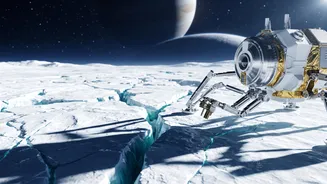
Before we can search for life in Europa's ocean, we have to get through its protective shell. This isn't a thin layer of ice like a frozen lake on Earth; scientists estimate Europa's crust is between 15 to 25 kilometers thick. The surface temperature
hovers around a frigid minus 160 degrees Celsius. Furthermore, the moon is bombarded by intense radiation from Jupiter's magnetic field. Any probe designed to breach this barrier must be incredibly robust, autonomous, and equipped for a long, lonely journey downwards through an environment we know very little about. The sheer thickness and extreme cold make traditional drilling nearly impossible, forcing engineers to think of more creative—and challenging—solutions.
The Thermal Approach: Melting Down
One of the most promising concepts is the 'cryobot'—a torpedo-shaped probe that would melt its way through the ice. These probes would use a heat source, likely a nuclear power system, to warm the ice in front of them. As the ice turns to water, the probe, pulled by gravity, would sink deeper, with the water refreezing behind it. This method is elegant because the waste heat from the probe's power source becomes a valuable tool. However, the challenges are immense. A cryobot would need a powerful and long-lasting energy supply, potentially requiring around 10 kilowatts of energy to melt through miles of ice over several years. Engineers are exploring concepts like the PRIME (Probe using Radioisotopes for Icy Moons Exploration) to tackle this very problem.
Mechanical Methods: Drills and Slush
Another school of thought focuses on mechanical drilling, but with a twist. A purely mechanical drill faces the risk of getting stuck as the ice it chips away refreezes. To solve this, concepts like the SLUSH (Search for Life Using Submersible Head) probe are being developed. This technology combines a rotating drill bit to break up the ice with a heat source to melt the resulting chips into a slush. This approach prevents the drill from freezing in place and helps clear the pathway down. This hybrid system could theoretically travel about two meters per hour, but the descent through kilometers of ice could still take years. Like the cryobot, it would need to be highly autonomous to navigate unforeseen obstacles within the ice.
Staying Connected from the Deep
Getting a probe into the ocean is only half the battle; the data it collects must be sent back to the surface lander, and then to Earth. Traversing kilometers of solid ice makes wireless communication impossible. The leading solution is a physical tether. Both cryobot and drill concepts plan to unspool a fiber optic cable as they descend. This tether would provide a physical link for transmitting power down to the probe and data back up to the lander. Protecting this thin, kilometers-long cable from snapping or damage as the ice shifts and the probe descends is a major engineering hurdle that scientists are actively working to solve. Some designs propose that if the main cable breaks, microfilaments could act as a backup antenna.
First Steps: Reconnaissance and Future Landers
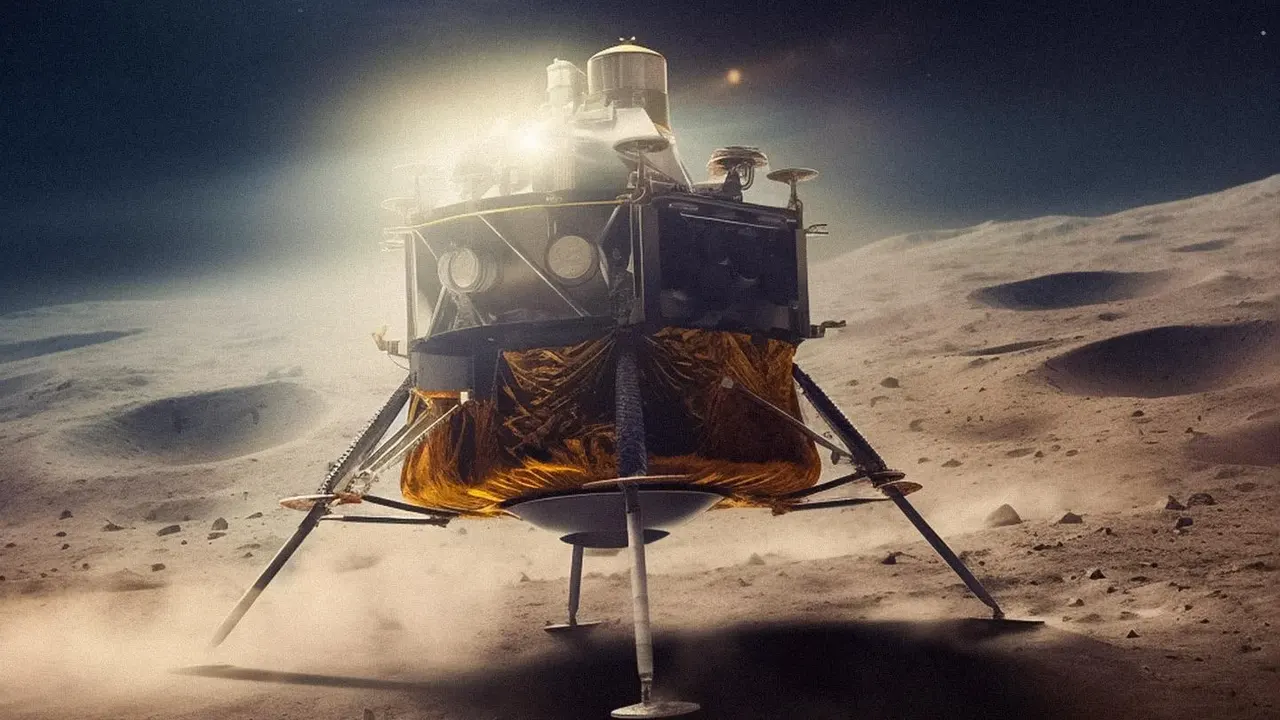
While no mission has yet attempted to penetrate Europa's shell, the groundwork is being laid. NASA's Europa Clipper mission, which launched in October 2024, is not a lander but an orbiter designed to perform detailed reconnaissance. Using instruments like ice-penetrating radar, it will map the thickness of the ice shell and confirm the ocean's existence and depth, searching for potential future landing sites. A proposed, but not yet funded, future Europa Lander mission would be the one to deploy these advanced penetrating probes. This lander would dig about 10 centimeters to analyze surface material, shielded from the worst radiation, while paving the way for a future mission to finally reach the ocean below.