



A Sweet Discovery in a Cosmic Cauldron
Astronomers have detected a sugar molecule called erythrulose for the first time in interstellar space. Using powerful radio telescopes in Spain, an international team of researchers spotted the chemical signature of this four-carbon sugar in a massive,
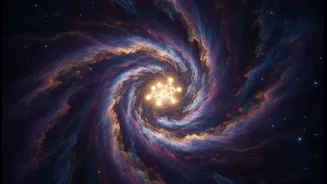
turbulent cloud of gas and dust known as G+0.693-0.027. This region, located about 27,000 light-years away near the supermassive black hole at the heart of the Milky Way, is a known cosmic factory for complex molecules. While simpler organic molecules related to sugars have been found before, this is the first definitive detection of a true sugar in the space between stars. On Earth, erythrulose is found in small amounts in raspberries and is also used in sunless tanning products.
Why Finding Sugar in Space Matters
Sugars are fundamental to life as we know it. They are a primary source of metabolic energy and, crucially, form the structural backbone of RNA and DNA, the molecules that carry genetic information. One of the biggest puzzles in origin-of-life research is how these first sugars formed on a young, prebiotic Earth. Laboratory experiments that try to simulate early Earth conditions have struggled to produce sugars in the quantities needed to kickstart biology. The detection of erythrulose in space supports an alternative theory: that the essential raw ingredients for life didn't have to form on Earth at all. Instead, they may have been delivered from space, pre-formed in cosmic clouds and then ferried to our planet aboard asteroids and comets. Researchers estimate that millions of tonnes of erythrulose could have landed on early Earth during a period of intense asteroid bombardment.
A Key Ingredient in Life's Recipe
Erythrulose itself is not a direct component of RNA or DNA, but it is a close chemical relative and a key stepping stone. It belongs to the same family of molecules and can be a precursor to other vital sugars, like ribose, which is a central component of RNA. Many scientists subscribe to the "RNA World" hypothesis, which posits that RNA, not DNA, was the first genetic material to arise. The discovery of an interstellar sugar that could lead to the formation of ribose strengthens the idea that the universe is naturally capable of producing the building blocks for such a world. The discovery was also surprising because researchers found erythrulose to be more abundant than simpler three-carbon sugars in the same region, challenging previous ideas that complex molecules form one carbon atom at a time.
From Stardust to New Worlds
The process begins in vast, cold molecular clouds like the one where erythrulose was found. In these interstellar nurseries, simple atoms and molecules freeze onto the surface of tiny dust grains, forming icy mantles. Within these ices, at temperatures around minus 250 degrees Celsius, chemical reactions slowly assemble more complex molecules. Over millions of years, gravity causes these clouds to collapse and form new stars and planetary systems. The dust and molecules from the original cloud become incorporated into a swirling disc around the young star, the very material from which planets, moons, asteroids, and comets are born. This means that when a planet like Earth forms, it is seeded from the very beginning with a rich inventory of complex organic compounds forged in the interstellar void.
Implications for Life Elsewhere
This discovery does not mean we have found extraterrestrial life. What it does show is that the chemical processes that produce life's raw ingredients are not unique to our solar system. They are happening across the galaxy. If the building blocks of life, like sugars and amino acids, are common in the star-forming regions of the Milky Way, it dramatically increases the odds that other planets could also have received the right starting materials. The detection of erythrulose deepens our understanding of prebiotic chemistry and gives scientists a clear target for future searches. With even more powerful telescopes coming online, astronomers hope to find even more complex sugars, potentially including ribose itself, which would be another major piece of the puzzle. The universe, it seems, is a very efficient chemist, stocking its stellar nurseries with the very stuff of life.