



The Physics of Sailing on Sunshine
At its core, a solar sail works by capturing momentum from sunlight. Light is made of particles called photons. While photons have no mass, they have momentum. When a countless stream of these particles strikes a large, reflective surface in the vacuum
of space, they transfer their momentum, giving the sail a tiny but continuous push. It's often confused with the solar wind, but a solar sail is propelled by light pressure, which is a much stronger force than the push from the solar wind's charged particles. Think of it like throwing tennis balls at a floating canoe; each ball gives it a small nudge, and with enough balls, the canoe starts to move and pick up speed.
Anatomy of a Solar Sail
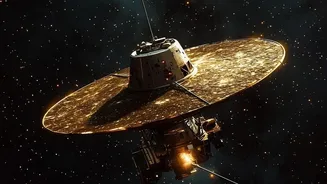
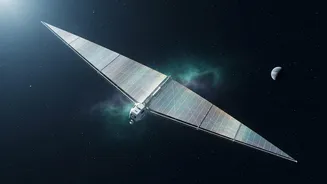
To be effective, a solar sail must be incredibly large, lightweight, and reflective. Most are made from ultra-thin materials like Mylar or Polyimide, coated with a layer of highly reflective aluminum. The entire sail assembly for a mission like The Planetary Society's LightSail 2, which had a surface area the size of a boxing ring, was made of a material just 4.5 microns thick—thinner than a human hair. These massive, gossamer sheets are packed into a small satellite, often a CubeSat, and unfurl in space using lightweight booms. The challenge is creating a structure that is vast enough to catch enough sunlight but light enough to be accelerated by it.
The Tortoise and the Hare Advantage
A solar sail's push is incredibly gentle—at Earth's distance from the Sun, the pressure is minuscule. So how does this lead to traveling 'faster'? The answer lies in constant acceleration. A traditional chemical rocket provides a massive, powerful burst of thrust for a few minutes and then coasts for the rest of its journey. A solar sail, however, accelerates continuously for its entire mission, as long as it's exposed to sunlight. This relentless, gradual buildup of speed means that over weeks, months, and years, a solar sail-propelled spacecraft can achieve velocities much greater than a conventional probe, which is limited by the fuel it can carry.
Putting the Sails to the Test
Solar sailing has moved from theory to proven reality. Japan's IKAROS mission became the first spacecraft to successfully demonstrate controlled solar sailing in interplanetary space during its flight to Venus in 2010. More recently, The Planetary Society's crowdfunded LightSail 2 mission, which operated from 2019 to 2022, successfully used a solar sail to change its orbit around Earth, proving the viability for small satellites. NASA has also invested in the technology with missions like NanoSail-D and the NEA Scout, which was designed to use a solar sail to visit a near-Earth asteroid after launching on the Artemis I mission.
The Future: Interstellar and Beyond
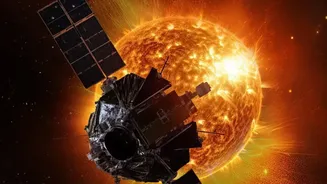
The technology isn't without its limits. The Sun's push gets weaker the farther a probe travels, reducing acceleration. However, engineers are already working on the next generation. One concept, known as 'extreme solar sailing,' involves a spacecraft making a close slingshot maneuver around the sun to achieve incredible speeds, potentially reaching the outer planets in months instead of years. Looking further, the same principle could be applied for interstellar travel. A concept called 'beam sailing' would use powerful, ground-based lasers to push ultra-lightweight sails, potentially accelerating probes to a significant fraction of the speed of light, opening a pathway to the stars.