

Your Pocket Guide to the Cosmos
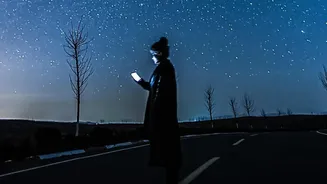
For centuries, navigating the night sky required complex paper charts, a deep understanding of celestial mechanics, and a very good memory. Today, anyone with a smartphone can point their device at the sky and instantly identify stars, planets, and constellations.
These stargazing applications have surged in popularity, democratizing astronomy by making it accessible to everyone. They act as a digital guide, overlaying information directly onto your view of the sky. But this seamless experience isn't magic; it's the result of a sophisticated interplay between the hardware already built into your phone and intelligent software that interprets the world around you.
A Symphony of Sensors
At the heart of every stargazing app are three key sensors working in unison: the GPS, the accelerometer, and the magnetometer. First, the GPS (Global Positioning System) receiver pinpoints your exact location on Earth. This is crucial because the view of the sky changes depending on your latitude and longitude. Next, the accelerometer, the same sensor that flips your screen orientation, determines the tilt and angle of your phone. It tells the app how you're holding the device relative to the ground. Finally, the magnetometer functions as a digital compass, detecting the Earth's magnetic field to determine which direction you are facing—north, south, east, or west. Together, this trio of sensors gives the app a precise understanding of your location and orientation.
Augmented Reality Brings It to Life
Once the app knows where you are and where your phone is pointing, it uses this data to power its core feature: augmented reality (AR). The software contains a vast, detailed map of the celestial sphere, cataloging hundreds of thousands, or even millions, of stars, planets, and other objects. Using the inputs from the sensors, the app calculates exactly which portion of this celestial map you should be seeing. It then overlays this map onto your phone's screen, often right over the live view from your camera. This creates a seamless blend of the real world and digital information. As you move your phone, the AR view moves in perfect synchrony, displaying labels, constellation lines, and artwork directly on top of the stars you're seeing with your own eyes.
Translating the View into Data
These apps do more than just put a name to a star. They translate the visual spectacle into a rich database of information, which is the "clear data" stargazers crave. Tapping on any object can bring up details like its distance from Earth, its brightness (magnitude), its official designation, and the mythology behind its constellation. Many apps include catalogs of not just stars, but also deep-sky objects like nebulae and galaxies. They can track the real-time position of the International Space Station (ISS) and other satellites, alerting you when they will pass overhead. Furthermore, many provide astronomical calendars for events like meteor showers or eclipses, and some can even show you what the sky looked like in the past or will look like in the future.
The Future of Amateur Astronomy
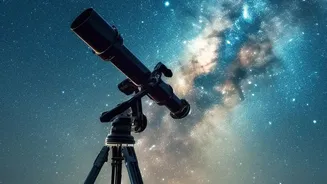
The technology continues to evolve, further blurring the line between amateur and professional tools. Some apps now integrate with smart telescopes, which are fully automated, app-controlled devices that can find, track, and photograph deep-sky objects for you. Instead of peering through an eyepiece, you watch a stunning, long-exposure image build on your tablet or phone screen. These systems use advanced techniques like live-stacking to cut through city light pollution, making deep-space observation possible even from urban backyards. While some traditionalists may miss the eyepiece, this app-driven approach is bringing the wonders of astrophotography to a whole new audience, suggesting a future where anyone can capture breathtaking images of the cosmos.