








More Than a Fruit, a Living Heirloom
To speak of mangoes in India is to speak of more than just a fruit; it's to invoke memories, regional pride, and a history stretching back 4,000 years. While names like Alphonso, Kesar, and Langra dominate the national conversation, they represent only
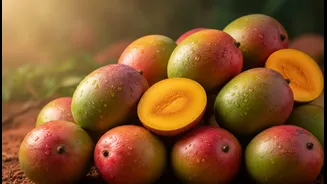
a tiny fraction of the estimated 1,500 varieties grown across the subcontinent. Many of the most unique mangoes are hyper-local, cherished and cultivated by specific communities who see them not as a commodity, but as a living heirloom. These are the custodian farmers, men and women who actively maintain agricultural biodiversity and its related knowledge, often over generations. Their orchards are not just farms; they are libraries of taste, genetics, and culture, holding stories that can’t be found in a supermarket.
The Story of a Single Tree
Consider the Malihabadi Dasheri. Its story begins not on a vast commercial farm, but with a single, remarkable tree discovered in the 1700s in a village near Lucknow. Local history credits the Nawabs of Awadh for first recognizing its exceptional qualities: fibreless flesh, a slim, elegant shape, and a distinct aroma. Legend has it the Nawab was so protective of this new fruit that he forbade cuttings from leaving his garden. But a flavour that good is impossible to contain. Through gardeners, guests, and family, grafts eventually spread, establishing the Malihabad region as the heartland for this beloved mango. Today, every Dasheri mango in the world can be traced back to that one 'mother tree'—a testament to the generations of farmers in Uttar Pradesh who perfected its cultivation. The story of the Dasheri is the story of Malihabad itself.
A Mark of Authenticity
In a market flooded with generic produce, how can these regional identities be protected? One powerful tool is the Geographical Indication (GI) tag. Similar to how “Champagne” can only come from its specific region in France, a GI tag certifies that a mango variety, like the Gir Kesar from Gujarat or the Banganapalli from Andhra Pradesh, originates from a specific geographical area and possesses qualities unique to that place. This legal protection helps prevent fraud, ensuring that a mango labelled 'Alphonso' actually comes from the Konkan region of Maharashtra, where the soil and climate create its signature taste. For farmers, the GI tag is a validation of their heritage and helps them command a fair price. For consumers, it’s a guarantee of authenticity—a direct link to the land and the community that grew the fruit.
The Threat of a Homogenised World
Despite these efforts, India’s staggering mango diversity is under threat. The commercial pressure to plant only a few high-yield, well-known varieties is immense. As a result, many traditional types like Tamil Nadu's Karuppatti Kai or West Bengal's Batasha are vanishing, remembered only by older generations. This isn't just a loss of biodiversity; it's the erosion of cultural and culinary heritage. Climate change poses another grave risk, with erratic weather, heatwaves, and new pests disrupting the delicate conditions needed for flowering and fruit development. When a unique mango variety disappears, a piece of a community’s history, its specific knowledge, and a flavour that can never be replicated is lost forever.
The Power of Community Conservation
The fight to save these mangoes is being led from the ground up. In Kannapuram, a village in Kerala, a police officer named Shyju Machathi inspired his community to document their local mangoes. Their efforts revealed an astonishing 207 indigenous varieties in their small area, leading to its declaration as an Indigenous Mango Heritage Area. Similarly, organisations like the Society for Conservation of Mango Diversity (SCMD) in Malihabad work with farmers to conserve and promote lesser-known varieties, creating community nurseries and finding new markets for these unique fruits. These initiatives prove that when a community takes ownership of its agricultural heritage, it can preserve it for the future. They are the living embodiment of the idea that these mango stories belong to those who maintain them.