



The Hidden Danger of Storm Surges
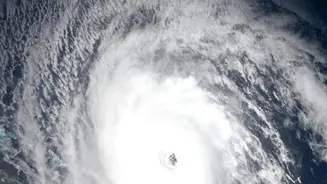
While heavy rainfall and high-speed winds are the most visible threats of a cyclone, the deadliest element is often the storm surge. A storm surge is a massive rise in sea level caused by the intense low pressure and powerful winds of a cyclone pushing
water towards the coast. This wall of water can flood coastal areas with devastating speed and force, inundating homes, destroying infrastructure, and posing a grave threat to life. For India, with its extensive 7,500-kilometre coastline and densely populated low-lying regions, the ability to accurately predict the height and timing of a storm surge is a matter of life and death. Without advance warning, communities have little time to evacuate, leading to catastrophic outcomes.
ISRO's Eyes in the Sky
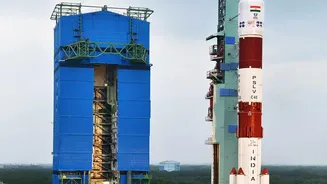
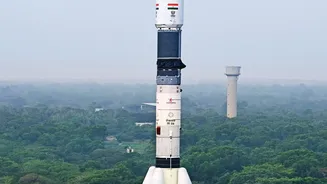
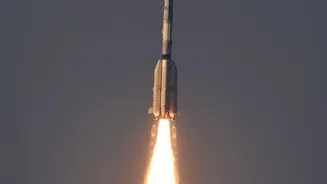
The Indian Space Research Organisation (ISRO) operates a multi-layered satellite system to keep a constant watch on the Indian Ocean region. The two primary pillars of this surveillance network are the INSAT (Indian National Satellite System) and the OceanSat series of satellites. Satellites like the recently launched INSAT-3DS are placed in geostationary orbit, about 36,000 km above the Earth, allowing them to continuously monitor weather patterns across the entire subcontinent. For more detailed ocean analysis, polar-orbiting satellites like EOS-06 (also known as OceanSat-3) circle the globe at a much lower altitude. These satellites are specifically equipped with instruments to measure key ocean parameters that are crucial for understanding the birth and behaviour of cyclones.
The Technology That Sees the Storm
These satellites carry advanced instruments that can see what ground-based systems cannot. The most critical tool for tracking storm surges is the satellite altimeter. This instrument works by sending a radar pulse down to the ocean and measuring the precise time it takes to bounce back. This allows it to detect the abnormal 'bulge' in sea level that signifies a developing storm surge. Another vital instrument is the scatterometer, found on satellites like EOS-06. It sends microwave beams to the ocean surface and measures how the radar signal scatters off the waves. A rough, choppy surface indicates high winds, allowing scientists to map wind speed and direction over vast, unmonitored stretches of the open ocean where cyclones form and gather strength. Together, these tools provide a complete picture of the storm's power.
From Data to Life-Saving Warnings
The raw data collected by ISRO's satellites is just the beginning. This stream of information on wind vectors, sea surface height, and temperature is transmitted to ground stations and fed into the supercomputers of the India Meteorological Department (IMD) and the Indian National Centre for Ocean Information Services (INCOIS). Here, the data is assimilated into sophisticated numerical weather prediction (NWP) models. These models simulate the atmosphere and ocean to forecast the cyclone's track, intensity, and potential storm surge with increasing accuracy. Based on these predictions, the IMD issues its well-defined, four-stage cyclone warnings, from a 'Pre-Cyclone Watch' 72 hours in advance to a 'Cyclone Warning' 24 hours before landfall, giving disaster management agencies and the public crucial time to prepare and evacuate.
A Proven Record of Saving Lives
The impact of this satellite technology is undeniable. The North Indian Ocean has historically been one of the world's deadliest basins for cyclones, largely due to a lack of observational data over the sea. In past decades, cyclones could form and intensify with little warning. Today, the story is vastly different. The improved tracking and forecasting enabled by satellites like the OceanSat and INSAT series have been credited with drastically improving the accuracy of warnings for recent powerful cyclones such as Amphan, Biparjoy, and Remal. This enhanced capability has led to more effective and timely evacuations, saving countless lives and significantly reducing the human cost of these powerful natural disasters compared to the tragedies of the past.