






A New Blueprint for Finding Life
For decades, the search for extraterrestrial life has focused on finding 'biosignatures' — specific chemicals like oxygen or methane that could indicate biological processes. While exciting, finding a single gas is not definitive proof of life. Geological
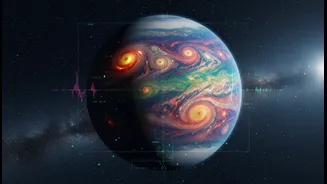
or chemical processes can mimic these signs, leading to potential false positives. Now, researchers are proposing a more robust method: searching for temporal or stable cycles. Instead of a static snapshot, they want to observe the movie. The idea is to look for predictable, repeating changes in a planet's atmosphere over time, much like the seasonal rise and fall of carbon dioxide on Earth caused by plant life.
How to Map a World Light-Years Away
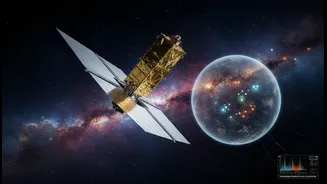
Mapping the atmosphere of a planet hundreds of light-years away sounds like science fiction, but it's happening now thanks to powerful instruments like the James Webb Space Telescope (JWST). The primary technique is called transit spectroscopy. As an exoplanet passes in front of its host star, a tiny fraction of the starlight filters through its atmosphere. Different molecules absorb light at specific wavelengths, leaving a unique chemical fingerprint in the light that reaches the telescope. By observing these transits repeatedly, astronomers can build a picture of the atmospheric composition and, crucially, detect if that composition is changing in a cyclical pattern. This could mean observing a planet through its seasons, a process that could take years of patient observation.
The Rhythmic Beat of a Living Planet
So, what are these 'stable cycles'? Think of them as a planet's breath. On Earth, for example, the massive bloom of plant life in the Northern Hemisphere's spring and summer draws down a significant amount of carbon dioxide from the atmosphere. In the autumn and winter, as plants decay, that CO2 is released back. This creates a measurable, yearly fluctuation — a stable cycle directly tied to life. An exoplanet with widespread biological activity might exhibit similar seasonal variations in gases like methane, oxygen, or carbon dioxide. Detecting such a repeating, predictable pattern would be far more convincing evidence of a dynamic, living ecosystem than just finding a static quantity of a single gas. It suggests an ongoing, planet-wide process is at play, something more akin to metabolism than simple geology.
Distinguishing Life from Geology
The key advantage of this new approach is its potential to rule out non-biological explanations. A volcanic eruption, for instance, might spew sulfur dioxide into an atmosphere, but this would likely be a one-time event, with the gas slowly dissipating. A biological source, however, might produce and consume a gas in a regular, sustained rhythm. This is why long-term climate stability, regulated by feedback loops, is considered a critical component of a habitable planet. On Earth, the carbonate-silicate cycle acts as a planetary thermostat over millions of years, regulating carbon dioxide and keeping the climate stable enough for life to thrive. Scientists believe that identifying signs of these regulatory cycles on an exoplanet would be a powerful indicator of its potential habitability.
The Long Road Ahead
This research is still in its early stages and faces significant hurdles. The signals from these distant atmospheres are incredibly faint, and distinguishing subtle, cyclical changes requires immense precision and long observation times. Furthermore, we only have one example of a life-bearing planet — Earth — which heavily influences our assumptions about what to look for. What if alien life operates on completely different cycles or chemistries? Despite these challenges, the ability to map atmospheres and look for dynamic change represents a monumental leap forward. Recent discoveries, like the first confirmed atmosphere around a rocky planet in its star's habitable zone, show we are rapidly gaining the capability to perform these complex investigations.