





A Cosmic Construction Site
Deep in the constellation Columba, a massive project is underway. The subject, known as MACS J0553.4-3342, is a colossal galaxy cluster that scientists are viewing as it was 4.4 billion years ago. Recent observations from the James Webb Space Telescope
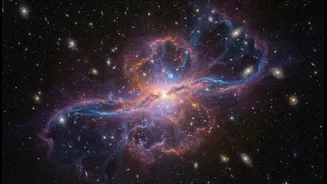
have led the European Space Agency to describe it as a “building site of significant scale.” This is not a single, settled structure but a dynamic scene of creation. At its heart, two smaller galaxy clusters are actively merging. They have already collided and passed through each other, and are now gravitationally bound to continue this cosmic dance until they coalesce into one enormous entity. This messy, energetic process involves immense clouds of superheated gas that glow brightly in X-ray light, data captured by observatories like NASA's Chandra. The two merging cores, each anchored by a supergiant elliptical galaxy, are the master builders in this vast, celestial construction zone.
The Sound of Starlight
While space is a vacuum and therefore silent, scientists have developed a fascinating way to experience cosmic data through hearing: data sonification. Pioneered by teams at NASA, including the Chandra X-ray Center, this process translates digital data from telescopes into sound. Information like brightness, colour, and position in an image are assigned attributes like pitch, volume, and even instrumental texture. For example, bright X-ray sources might become high, clear synthesizer notes, while the faint infrared glow of cosmic dust could be represented by the sustained tones of a string section. This technique offers a completely new dimension for interpreting astronomical information, making complex structures accessible to a wider audience, including blind and visually impaired communities. It allows us to listen to the patterns, rhythms, and textures hidden within a celestial image, turning a static picture into a dynamic soundscape.
Gravity as the Architect
The “architecture” of MACS J0553 is not just metaphorical; it has a real, physical impact on its surroundings. The sheer mass of the merging clusters—a combination of galaxies, hot gas, and unseen dark matter—is so immense that it warps the very fabric of spacetime around it. This phenomenon, predicted by Albert Einstein's theory of general relativity, is known as gravitational lensing. The cluster acts like a giant, natural lens in space, bending and magnifying the light from much more distant galaxies located directly behind it. In the recent Webb telescope images of MACS J0553, these background galaxies appear as distorted, stretched-out orange arcs of light. In this sense, the cluster is an active architect, redesigning the light that passes through its domain and giving astronomers a powerful magnifying glass to study objects that would otherwise be too faint and distant to see.
Hearing the Blueprint
So, what would this cosmic architecture sound like? While no official sonification of MACS J0553 has been released, we can imagine how the process would translate its structure into audio. The intense, high-energy X-ray gas filling the space between the merging clusters might be rendered as a harsh, buzzing sound, its volume swelling where the gas is densest. The two central, supergiant galaxies could be represented by deep, powerful tones, the gravitational anchors of the composition. The smaller galaxies scattered throughout the cluster would become intermittent, lighter notes. Most evocatively, the warped, lensed arcs of the distant background galaxies could be translated into sweeping, glissando-like sounds, their pitch rising and falling as the light is bent and distorted by the cluster's immense gravity. The result would be a complex auditory blueprint—a symphony of structure, revealing the violent, beautiful process of a galaxy cluster being built, note by note.