

The Blueprint for a 'Goldilocks' World
The most fundamental clue Earth provides is the concept of the “habitable zone,” often called the 'Goldilocks zone'. This refers to the region around a star where conditions are not too hot and not too cold for liquid water to exist on a planet's surface.
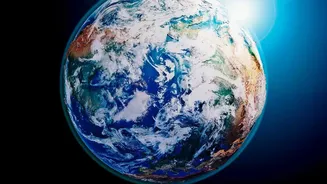
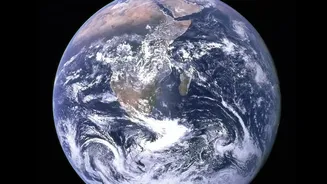
Since liquid water is a key ingredient for life as we know it, this is the first filter scientists apply in their search. However, modern science shows that distance from a star is just the beginning. A planet's size, mass, and the presence of an atmosphere are equally crucial. Earth teaches us that a stable climate, capable of supporting liquid water, depends on a complex interplay of factors, including a planet's ability to trap the right amount of heat through its atmosphere—a planetary-scale greenhouse effect.
Reading an Alien Atmosphere
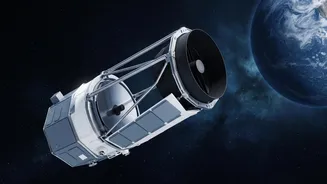
How can we know what's in the air of a planet light-years away? The answer lies in studying starlight. When an exoplanet passes in front of its host star, a technique called transmission spectroscopy allows powerful instruments like the James Webb Space Telescope (JWST) to analyze the starlight filtering through the planet's atmosphere. The molecules in the atmosphere absorb specific wavelengths of light, leaving behind a chemical fingerprint. Earth's atmosphere, rich in oxygen, methane, and water vapor, provides the perfect reference. The presence of oxygen, in particular, is a strong potential 'biosignature'—a sign of life—because on our planet, it is continuously replenished by photosynthesis. The simultaneous presence of gases that shouldn't coexist, like methane and oxygen, is an even stronger hint, suggesting a biological source is actively maintaining this chemical imbalance.
Lessons from a Time Machine
Earth hasn't always looked the way it does today. Over its 4.5-billion-year history, our planet has gone through many phases, from a volcanic world with an oxygen-poor atmosphere to a snowball planet covered in ice. Each of these ancient versions of Earth serves as an analog for what we might find elsewhere. A newly discovered exoplanet might not look like modern Earth, but it could resemble our planet during its Archean Eon, when microbial life thrived in an oxygen-free environment, producing methane. By studying Earth's geological and biological evolution, scientists can create models for planets at different stages of their development. This helps them recognize that a world doesn't need to be an exact twin of modern Earth to be considered a candidate for life; it might just be a younger or different version of it.
Searching for Signs of Technology
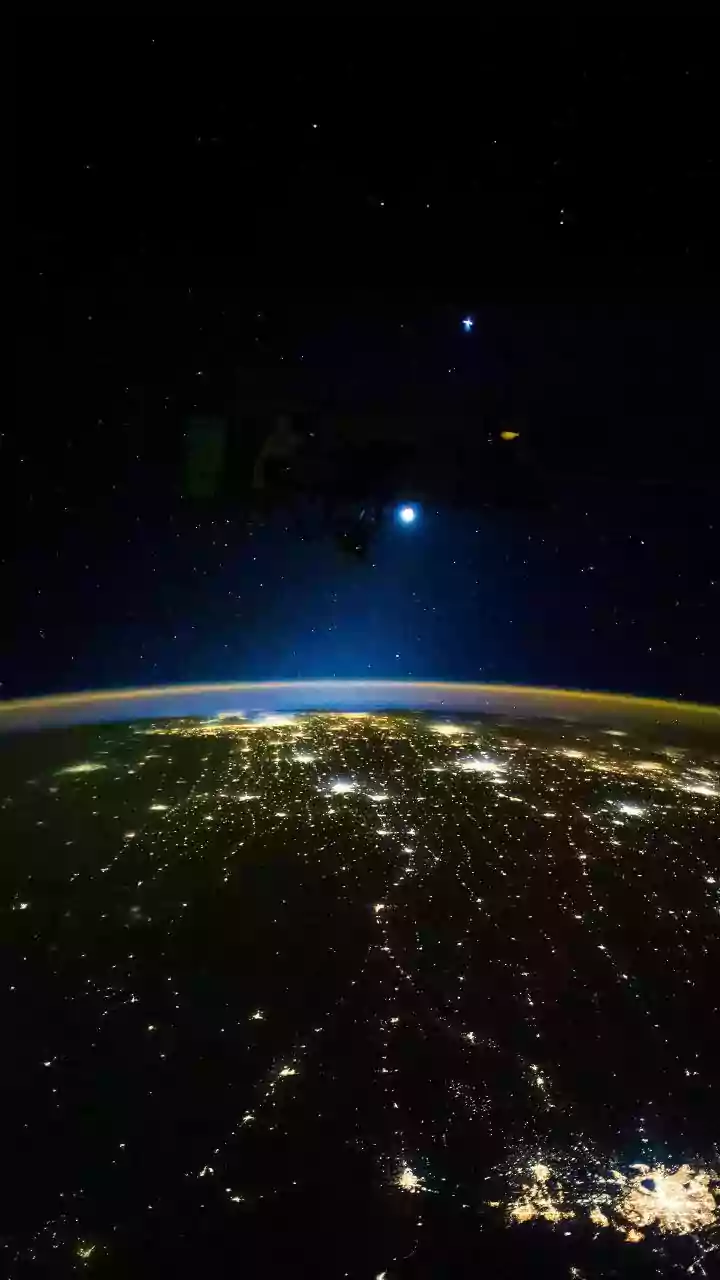
Beyond looking for biological clues, some scientists are searching for 'technosignatures'—evidence of advanced alien technology. Again, Earth provides the model. Our own civilization produces signals that could be detected from afar, including radio transmissions, the chemical signatures of industrial pollution in our atmosphere (like nitrogen dioxide), and the glow of city lights on the night side of the planet. The Search for Extraterrestrial Intelligence (SETI) has long been focused on scanning for deliberate radio signals, but the search for technosignatures has broadened to include these passive byproducts of a technological society. While a long shot, spotting an unusual chemical like chlorofluorocarbons (CFCs) or strange patterns of infrared heat could be an unmistakable sign that we are not alone.