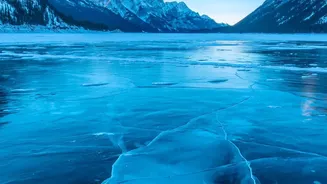


A frozen lake can appear as a vast, silent expanse of white. But look closer, and you’ll find a gallery of natural art. These intricate patterns and strange formations aren't random; they are stories told by physics, chemistry, and biology.
The Science of a Still Canvas
Before any
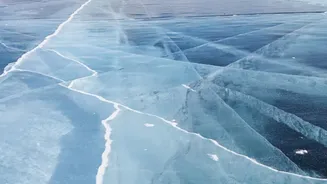
pattern can emerge, a lake must first freeze. This process is more complex than it sounds. As air temperatures drop, the surface water cools, becomes denser, and sinks. This forces warmer water from below to rise, creating a cycle. Water is unique because it reaches its maximum density at about 4°C, not at freezing point. Once the entire lake cools to this temperature, the surface water can finally drop to 0°C and begin to form ice crystals. Because ice is less dense than liquid water, it floats, forming an insulating layer on top. The clearest, most pristine ice—often called 'black ice'—forms when this process happens slowly on a calm day, allowing impurities and air to be pushed out, creating a perfect, transparent canvas for nature's art.
Trapped Methane Bubbles
One of the most photographed phenomena is stacks of frozen bubbles, which look like suspended white discs or jellyfish. These are bubbles of methane gas. At the bottom of many lakes, bacteria decompose organic matter like dead plants and animals. This decomposition releases methane gas, which rises to the surface. In summer, the bubbles simply pop and escape into the atmosphere. But in winter, as the lake freezes in layers, these bubbles get trapped. As the ice thickens, new bubbles are captured below the previous ones, creating vertical stacks that serve as a visual record of the lake’s winter-long exhalation. While beautiful, this phenomenon highlights the release of a potent greenhouse gas, a process amplified by thawing permafrost in arctic regions.
Delicate Frost Flowers
Under very specific and rare conditions, a frozen lake can bloom with 'frost flowers'. These are not plants but intricate, feathery ice structures that grow on the surface of new, thin ice. They form when the air is much colder than the ice surface—typically a difference of at least 15°C. In these conditions, moisture from the warmer ice sublimates (turns from solid to vapor) and then quickly freezes upon hitting the frigid air, forming delicate, branching crystals. Calm, windless conditions are essential, as even a slight breeze would disrupt their fragile growth. Though they look like something from a fantasy world, frost flowers are a fleeting display of thermodynamics at work, usually melting or sublimating as soon as the sun rises.
Fractals and Crystal Stars
The geometric beauty of ice doesn't stop with flowers. On fresh, clear 'black ice', spectacular fractal patterns can emerge, looking like frozen lightning or giant snowflakes stretching across the surface. These are known as dendritic structures, or 'lake stars'. They form due to instabilities during the freezing process, where the advancing front of ice crystals branches out in complex, repeating patterns. Sometimes, this is caused by thermal stress cracking the ice in a fractal pattern. In other cases, a light snowfall on very thin ice can cause slightly warmer water from below to well up through micro-cracks, melting channels into the slushy snow before refreezing into a stunning star-like shape.
The Unstoppable Force of Ice Shoves
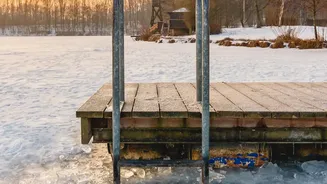
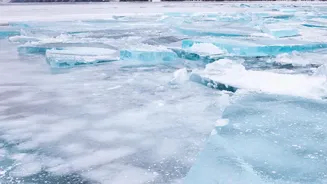
Not all lake ice phenomena are delicate. An 'ice shove' or 'ice tsunami' demonstrates the immense power of frozen water. This occurs when large sheets of lake ice are pushed onto the shore, creating rumbling piles that can be several meters high. Ice shoves are typically driven by strong, sustained winds or rapid temperature fluctuations that cause the ice sheet to expand. After a period of melting creates some open water, wind can get a grip on the massive, free-floating ice sheet, driving it forward with unstoppable momentum. The results can be destructive, easily damaging buildings, docks, and trees along the shoreline, serving as a powerful reminder of the dynamic forces at play on a seemingly tranquil frozen lake.