




A Cosmic Mystery Solved
For decades, astronomers have been puzzled by Omega Centauri, a massive, ancient star cluster packed with around 10 million stars. Theoretical models predicted that this dense stellar city, one of the oldest objects in the universe, should be littered
with thousands of smaller, stellar-mass black holes—the remnants of giant, exploded stars. Yet, despite numerous searches, none had been definitively found. That changed recently when an international team of astronomers announced the discovery of the very first one. Using a clever technique and a trove of archived data, they finally unmasked one of the cluster's hidden residents, solving a long-standing cosmic mystery.
The Invisible Dance Partner
Since black holes don't emit any light, finding them requires indirect methods. Previous searches in Omega Centauri used techniques like looking for X-ray emissions from gas falling into a black hole, but these came up empty. This time, scientists turned to astrometry, the precise measurement of the positions and movements of stars over time. By painstakingly analyzing over 20 years of archival data from the Hubble Space Telescope, enhanced with recent, sharp observations from the James Webb Space Telescope, they identified a single star performing a curious wobble. Its movement could only be explained if it was orbiting an unseen, massive companion. By calculating the mass of this invisible partner, they concluded it had to be a black hole.
Introducing oMEGACat BH-2
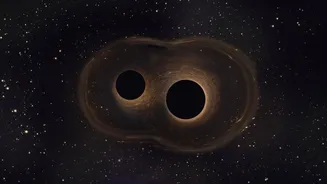
The newly discovered object, dubbed oMEGACat BH-2, is the first stellar-mass black hole confirmed in Omega Centauri. However, the discovery came with some surprises. The black hole and its companion star are in an unusually long orbit, taking 94 years to complete one cycle—the longest orbital period ever recorded for such a binary system. This finding is more than just a new entry in the cosmic catalogue. These dense globular clusters are thought to be prime locations for the formation of black hole binaries, which eventually merge and produce the gravitational waves now being detected on Earth. Understanding how these systems form is crucial for interpreting those gravitational wave signals, which are opening a new window onto the universe's most extreme events.
From Stellar to Supermassive
This discovery also sheds light on the broader family of black holes. Astronomers have found plenty of small, stellar-mass black holes (a few times the mass of our sun) and supermassive ones (millions to billions of solar masses) at the centers of galaxies. But the ones in between, known as intermediate-mass black holes (IMBHs), have been notoriously hard to find. Interestingly, previous evidence has suggested that an IMBH may also lurk at the very center of Omega Centauri. The confirmation of a smaller, stellar-mass black hole in the same cluster provides a more complete picture of how these objects coexist and evolve. Scientists believe IMBHs may grow from the merger of smaller black holes, eventually becoming the seeds for the supermassive giants that anchor entire galaxies. Finding and studying all sizes of black holes in a single cluster is like finding different life stages of an animal in one habitat, offering vital clues to their life cycle.