



An Invisible, Global Problem
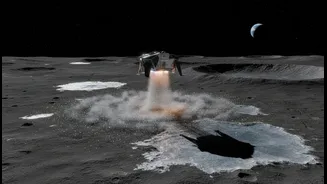
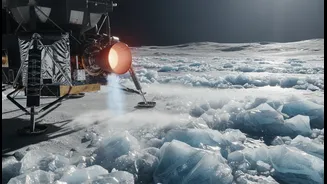
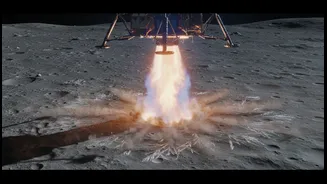
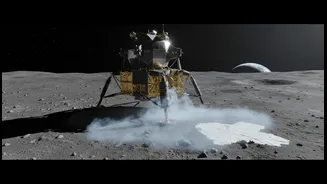
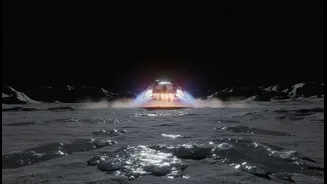
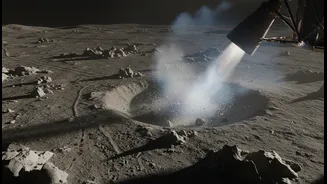
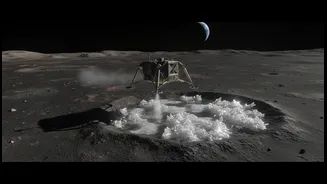
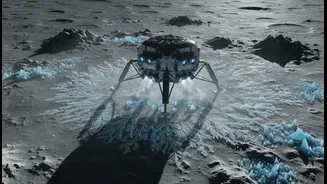
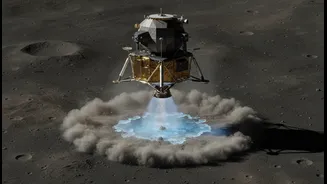
When a spacecraft makes its final descent onto the lunar surface, its powerful rocket engines fire to ensure a soft landing. In the Moon's near-vacuum, the exhaust plume doesn't behave as it does on Earth. Instead of being contained by atmospheric pressure,
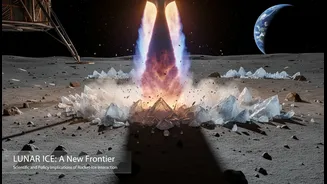
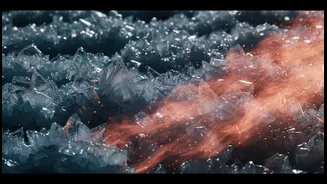
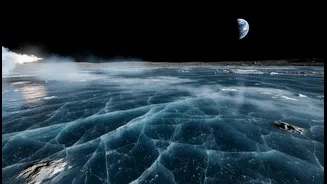
it expands dramatically, shooting gases and particles horizontally at high speeds. Recent studies using computer simulations have revealed a startling consequence: these exhaust gases don't just settle around the landing site. Within hours, molecules like water and methane can spread across the entire lunar globe. Research shows that a significant portion of this exhaust can persist for months, eventually freezing and settling in the coldest parts of the Moon—the same permanently shadowed regions (PSRs) where ancient water ice is found.
What's in the Exhaust?
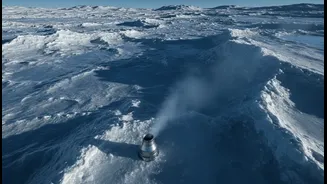
The primary components of most lander exhaust are themselves volatile chemicals. For instance, many landers use propellants that produce water (H2O) and carbon compounds like methane as byproducts. When these man-made molecules rain down on the polar craters, they mix with and contaminate the native ice. This pristine ice is a scientific treasure chest, believed to hold a frozen record of the early solar system and possibly even prebiotic organic molecules delivered by comets and asteroids billions of years ago. Introducing modern exhaust chemicals can corrupt this record, making it difficult for scientists to distinguish between what is authentically ancient and what is recent pollution from our own spacecraft. One study estimated that a single large lander could deposit tons of water into these sensitive regions, potentially overwhelming the natural signals scientists hope to measure.
The High Stakes of Contamination
The concern goes beyond purely scientific pursuits. A key pillar of plans for a sustainable human presence on the Moon, such as NASA's Artemis program, is In-Situ Resource Utilization (ISRU). This means living off the land by harvesting local resources. Lunar ice is the most valuable of these resources; it can be melted for drinking water, split into oxygen for breathing, and processed into hydrogen and oxygen for rocket fuel. If these ice deposits become contaminated with other chemicals from rocket exhaust, it complicates the purification process and reduces their utility. Essentially, we risk spoiling the well before we even get a chance to drink from it. The problem is urgent, as multiple government agencies and commercial companies are planning missions to the lunar south pole, the very area rich in this ice.
Smarter Landings and Greener Fuels
The solution requires a two-pronged approach: more careful planning of where to land and what propellants to use. One strategy is to select landing sites that are a safe distance from known ice deposits. Astronauts or rovers could then travel to the permanently shadowed regions to collect samples, minimizing direct contamination from the landing plume. Another crucial area of development is in "green" propellants. NASA's Green Propellant Infusion Mission (GPIM) has already successfully tested a less toxic, higher-performance alternative to traditional hydrazine fuel. These new fuels, such as hydroxylammonium nitrate (HAN) blends, are not only safer to handle on Earth but can also be chosen for their less-contaminating exhaust byproducts. The goal is to develop propulsion systems that are powerful enough for landing but gentle enough on the delicate lunar environment.