



What Is the Roman Space Telescope?
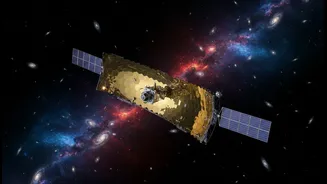
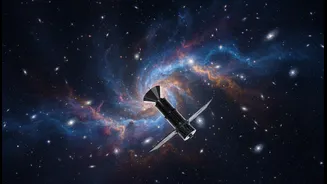
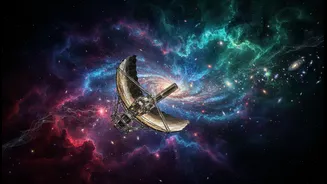
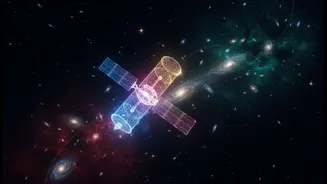
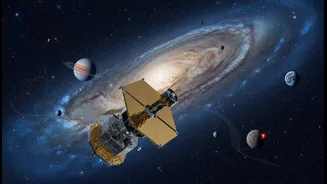
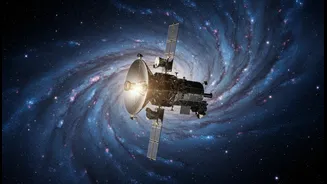
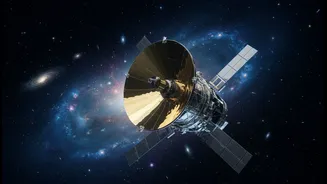
Scheduled for launch in August 2026, the Nancy Grace Roman Space Telescope is a NASA observatory built to explore essential questions about dark energy, dark matter, and exoplanets. It is named after Dr. Nancy Grace Roman, NASA's first Chief of Astronomer,
often called the “mother” of the Hubble Space Telescope. The telescope features a 2.4-meter primary mirror, the same size as Hubble's, but it is equipped with a revolutionary Wide Field Instrument. This instrument gives Roman a field of view at least 100 times greater than Hubble's, allowing it to map vast regions of the sky with incredible speed and efficiency. It will operate in an orbit about 1.5 million kilometers from Earth, far from our planet's heat and light, which is crucial for its sensitive infrared observations.
How Is It Different from Hubble or Webb?
While Hubble, Webb, and Roman are all powerful space observatories, they are designed for different tasks. Think of Webb and Hubble as microscopes, built for detailed, deep dives into specific cosmic objects. Roman, on the other hand, is like a wide-angle camera, built for massive surveys. Its primary strength is capturing enormous cosmic panoramas with the same high resolution as Hubble. This means Roman can create vast maps of the universe much faster than its predecessors. What might take Hubble years to survey, Roman can accomplish in months or even days. The three telescopes will work together; Roman will identify tens of thousands of new targets, and Webb and Hubble can then be used to study the most interesting ones in greater detail.
How Will It Hunt for Dark Matter?
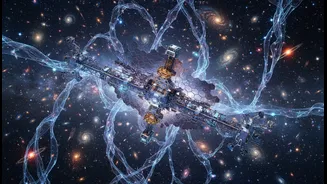
Dark matter is an invisible substance that makes up about 85% of the matter in the universe, but it doesn't emit or reflect light. We know it exists because of its gravitational pull on the things we can see. Roman will map the distribution of dark matter by studying a phenomenon called gravitational lensing. When light from a distant galaxy passes by a massive object (like another galaxy or a huge clump of dark matter), its path is bent. Roman's Wide Field Instrument will precisely measure these tiny distortions in the shapes of hundreds of millions of galaxies. By analyzing these distortions, scientists can create a detailed map of the unseen dark matter scaffolding that holds the universe together, providing crucial clues to its fundamental nature.
How Will It Find Thousands of New Exoplanets?
Roman is expected to be a prolific planet hunter, with projections that it could discover over 100,000 new exoplanets. It will use two main techniques. One is the transit method, where the telescope detects the slight dimming of a star's light as a planet passes in front of it. But its primary planet-finding method will be gravitational microlensing. This occurs when a star with a planet passes in front of a more distant star. The foreground star's gravity acts as a natural magnifying glass, briefly making the background star appear brighter. The planet adds its own small, additional spike to this brightening event. Because this technique can detect planets that are very far from their star and even rogue planets not orbiting any star at all, Roman will provide a more complete census of the planetary systems in our galaxy.
What Are Galaxy Surveys and Why Do They Matter?
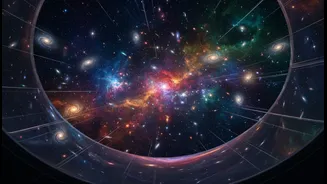
A key part of Roman's mission is to conduct enormous galaxy surveys, creating the largest and most detailed 3D maps of the universe ever made. One of its main observation programs, the High-Latitude Wide-Area Survey, will photograph hundreds of millions of galaxies to study the structure and evolution of the cosmos. These vast surveys are crucial for understanding large-scale cosmic patterns. By measuring the precise positions and distances of so many galaxies, scientists can investigate how cosmic structures like galaxy clusters have grown over billions of years. This data is also essential for tackling the mystery of dark energy, the unknown force that is causing the expansion of the universe to accelerate. Roman's panoramic view will give us a fresh perspective on how the universe has changed over time.