


The Standard Recipe for Giants
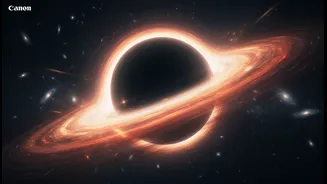
For decades, the story of supermassive black holes seemed straightforward. When a very massive star runs out of fuel, its core collapses, creating a stellar-mass black hole, perhaps a few dozen times the mass of our sun. Over billions of years, these
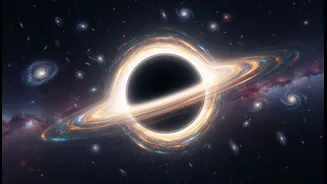
'seeds' grow by pulling in surrounding gas and dust. They also merge with other black holes when their host galaxies collide. Think of it like a snowball rolling downhill, gradually accumulating more and more snow. This process is steady, predictable, and, most importantly, slow. According to this model, it should take a very long time—much of the universe's 13.8 billion-year history—to form the giants we see today at the centers of galaxies like our own Milky Way. These behemoths, millions or billions of times the sun's mass, were thought to be the result of a long, patient process of cosmic evolution.
A Glitch in the Cosmic Timeline
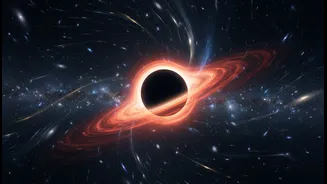
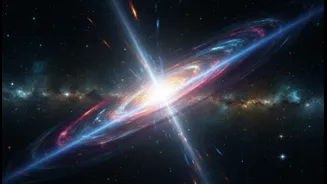
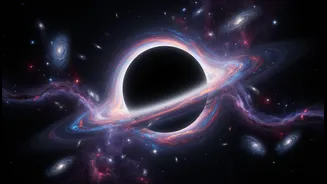
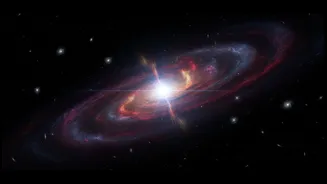
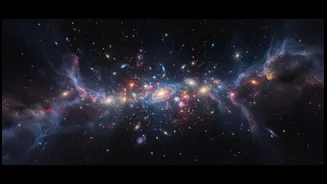
The James Webb Space Telescope (JWST) has given humanity an unprecedented window into the 'Cosmic Dawn', the era just a few hundred million years after the Big Bang. What it's finding there is breaking the models. Astronomers are spotting objects like quasar J0313-1806, powered by a black hole 1.6 billion times the mass of the sun, seen when the universe was only 670 million years old. More recently, another active black hole was confirmed in a galaxy just 570 million years after the Big Bang. These are not just slightly bigger than expected; they are colossal. Finding a black hole this massive, this early, is like finding a fully grown adult in a nursery. There simply wasn't enough time, according to the standard recipe, for them to have grown so large. The timeline just doesn't add up.
Too Big, Too Fast
The problem isn't just the short timeframe; it's also about physics. There's a physical speed limit on how fast a black hole can eat, known as the Eddington limit. If a black hole consumes matter too quickly, the intense radiation blasted out by the superheated material pushes away the very gas it's trying to feed on, effectively choking itself. Even if a seed black hole had a constant, all-you-can-eat buffet from the moment it formed, growing to billions of solar masses in just a few hundred million years would require it to consistently feed at or above this physical limit, a scenario most astrophysicists find unlikely. Some of these early black holes are also bizarrely large compared to their host galaxies, defying the observed rule that galaxies and their central black holes should grow in tandem.
In Search of 'Heavy Seeds'
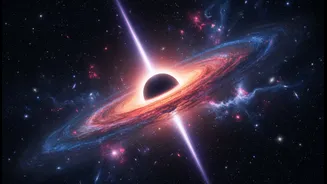
Since the 'light seed' model of stellar collapse is struggling to explain these cosmic titans, scientists are exploring more exotic origins. The leading alternative is the 'heavy seed' model, also known as a 'direct collapse' black hole. In this scenario, a truly enormous cloud of primordial gas in the early universe, under very specific conditions, could have skipped forming stars altogether and collapsed directly into a black hole. This would create a starting 'seed' that was already huge—perhaps 100,000 times the mass of the sun. Starting with such a massive seed would give these black holes the head start they needed to reach a billion solar masses in the short time available. Another, even more speculative idea, involves primordial black holes, which might have formed from dense regions of energy in the immediate aftermath of the Big Bang itself, before the first stars even existed.
Rewriting the First Chapter of the Universe
This puzzle is more than just a black hole mystery; it's about the very architecture of the cosmos. Supermassive black holes are not just passive objects; they are powerful engines that shape the galaxies around them. Their immense gravity and energy output can trigger or shut down star formation, effectively sculpting how their host galaxy evolves. Understanding how these first giants formed so quickly is essential to understanding why galaxies look the way they do today. The discoveries from JWST and other observatories are forcing a rethink of the first chapter of cosmic history. These 'impossible' objects are not a flaw in our observations but a clue that our understanding of the universe's youth is incomplete.