




Let’s Start With Earth
To understand how truly strange Venus is, let's quickly recap our own planet’s rhythm. An Earth 'day' is the time it takes for the planet to complete one full rotation on its axis—about 24 hours. An Earth 'year' is the time it takes to complete one full orbit
around the Sun—about 365.25 days. Simple enough. We experience over 365 sunrises and sunsets in the time it takes us to travel once around our star. This feels normal, intuitive, and it’s the basis for how we measure our lives. Hold onto this concept, because Venus is about to turn it completely upside down.
Welcome to Venus, Our Bizarre Twin
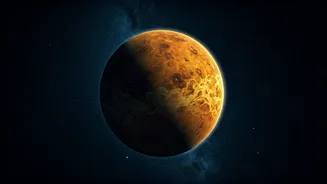
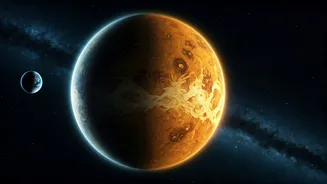
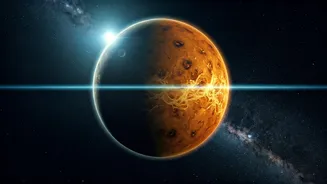
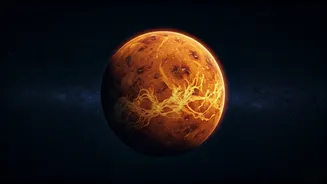
Venus is often called Earth's twin. It's similar in size, mass, and composition. But the similarities end there. Its surface is a scorching hellscape hot enough to melt lead, hidden beneath thick, toxic clouds. And its timing is a complete mess. A year on Venus—the time it takes to orbit the Sun—is roughly 225 Earth days. But a day on Venus—the time it takes to complete one single rotation on its axis—is a mind-boggling 243 Earth days. Read that again. It takes longer for the planet to spin once than it does for it to complete its entire journey around the Sun. If our lives were timed by planetary rotations, a single Venusian day would outlast a Venusian year by 18 Earth days.
The Crucial Twist: Two Types of 'Day'
Here’s where it gets even weirder and the headline’s claim is clarified. We have to distinguish between two types of days. The first is a 'sidereal day', which is the time it takes for a planet to rotate 360 degrees on its axis relative to distant stars. For Venus, this is the 243-Earth-day figure. This is the true measure of a single spin. However, there’s also the 'solar day', which is the time it takes for the Sun to appear in the same position in the sky (e.g., from one sunrise to the next). On Earth, our sidereal and solar days are very close—only about four minutes different. On Venus, the difference is enormous. Because Venus rotates backwards (retrograde) and incredibly slowly, a solar day is dramatically different.
Sunrise on Venus: A Long Wait
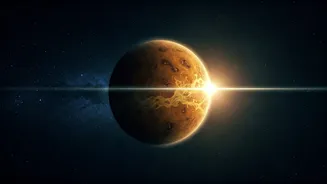
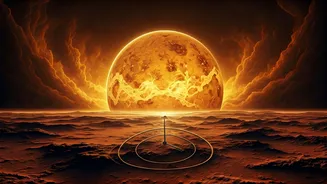
While a single spin takes 243 Earth days, you wouldn't have to wait that long for the sun to rise again if you could somehow survive on the surface. Because the planet is rotating backwards as it moves forward in its orbit, the Sun actually appears to return to the same spot in the sky much faster. The time between one sunrise and the next on Venus—its solar day—is about 117 Earth days. So, while a single spin (sidereal day) is longer than a year, the perceived day-night cycle (solar day) is shorter. This means you'd experience roughly two sunrises per Venusian year. Each 'daylight' period would last nearly two Earth months, followed by an equally long night.
Why is Venus So Weird?
Scientists are still debating why Venus spins so slowly and in the opposite direction of most other planets in the solar system. One leading theory suggests that its incredibly thick and heavy atmosphere—90 times denser than Earth’s—creates so much friction on the surface that it has acted like a brake, slowing the planet's rotation over billions of years. This dense atmosphere, locked in a runaway greenhouse effect, is what makes Venus the hottest planet in the solar system. Another theory posits that a massive collision with another planetary body early in its history could have literally knocked it upside down or reversed its spin. Whatever the cause, the result is a world with a truly alien sense of time.