




What Are Content Credentials?
At its core, a Content Credential is like a digital nutrition label attached to a media file, such as a photo, video, or document. This label, which is cryptographically signed to be tamper-evident, carries information about the file's journey. It can
tell you who created the content, what tools they used (including specific AI generators), when it was made, and what edits have been applied since its creation. This initiative is spearheaded by the Coalition for Content Provenance and Authenticity (C2PA), a group including major tech and media companies like Adobe, Microsoft, Google, and the BBC, who are creating an open standard for everyone to use. The goal isn't to block or censor content, but to provide a clear, verifiable history—its provenance—that anyone can check.
How the 'Digital Receipt' Works
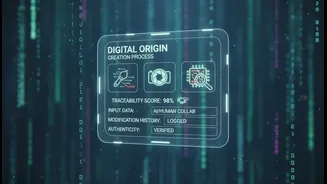
The process is designed to be additive, creating a chain of custody. It starts at the moment of creation. A C2PA-enabled camera or AI tool generates the initial credential, signing the file with a cryptographic seal. If that file is then opened in editing software like Adobe Photoshop, any significant changes—such as cropping, colour correction, or using generative AI to add or remove elements—are logged and added to the credential's history. Each step is added as a new layer, so the full history remains intact. When you encounter a piece of content with a credential, you'll often see a small icon. Clicking it reveals this stored history, allowing you to see its origins and modifications. The cryptographic signature ensures that if someone tries to alter the file or its history without using a compliant tool, the seal will be 'broken', indicating potential tampering.
The Receipt Analogy Explained
This is where the 'receipt' comparison becomes critical. When you buy something, the receipt proves where and when you bought it and what you paid. It doesn't, however, say anything about why you bought it or whether the item itself is of high quality. The receipt is a factual record of a transaction, not a judgment of its value or intent. Content Credentials work the same way. They provide a tamper-evident record of an image’s history—that it was captured on a specific camera or generated by a particular AI model. This is incredibly useful for transparency. But it does not, and cannot, verify that the content of the image is factually 'true'. A photographer can stage a misleading scene, and a compliant camera will truthfully sign the resulting photo, credential and all.
So, What Can't They Do?
The most significant limitation is that Content Credentials do not verify truth. They authenticate the file's history, not the reality of its subject matter. Furthermore, the system is currently opt-in. A creator must choose to enable it, and the content must be handled by C2PA-compliant software and platforms to preserve the chain of information. A major loophole is that credentials can be easily stripped. Simply taking a screenshot of an image creates a brand new file with no history, effectively washing it clean of its original credential. Similarly, many social media platforms and messaging apps automatically strip metadata from files to save space, though this is slowly changing. Because the system is not yet universal, the absence of a credential doesn't mean a file is fake; it could simply be from an older camera or a creator not using the technology.
The True Value of Transparency
If Content Credentials aren't a foolproof truth machine, what is their purpose? Their value lies in creating a new baseline of transparency and accountability. For news organisations, they can prove a photo came from their photojournalist on the ground. For artists, they offer a persistent form of attribution that travels with their work. For the average person, it provides a powerful tool to ask critical questions. Seeing a credential that states an image was generated by AI gives you immediate, crucial context. It shifts the conversation from a hopeless landscape where anything could be fake to one where we can begin to trace content back to its source. It’s a system built not to give us all the answers, but to give us the right information to ask better questions.