



A Needle in a Cosmic Haystack
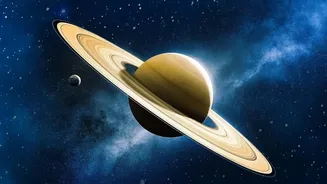
Imagine trying to spot a car-sized, non-reflective object from hundreds of millions of kilometres away, right next to a celestial body as enormous and bright as Saturn. That is the fundamental challenge facing astronomers. These tiny moons, some just
a few kilometres across, are incredibly faint. They are easily lost in the overwhelming glare of their parent planet, which outshines them by an immense factor. The vastness of space and the sheer number of objects, from dust particles to distant stars, create a noisy backdrop. Finding a potential moon is like trying to hear a single pin drop in the middle of a rock concert. The first step is simply capturing an image that might contain a new object, a task often performed by powerful tools like the Hubble Space Telescope or dedicated probes like the Cassini spacecraft.
The Problem of 'Seeing Things'
A single image showing a faint dot where none was seen before is not nearly enough to announce a discovery. The universe is full of transient phenomena that can mimic a moon. A cosmic ray hitting a camera's sensor, a temporary instrument glitch, or even a distant asteroid passing through the field of view can create a false positive. This is where the concept of the signal-to-noise ratio (SNR) becomes critical. The 'signal' is the genuine light from the potential moon, while the 'noise' is all the random interference from the background and the equipment itself. If the noise is high, it can easily create a phantom signal or drown out a real one. A single detection has a low SNR, making it impossible to say with certainty if the dot is a real object or just a random flicker in the data.
The Power of a Second and Third Look
To begin separating signal from noise, scientists must observe the same patch of sky again. By taking multiple images over a period of time, they can check if the faint dot reappears. If it was just random noise, it is highly unlikely to show up in the same place twice. If the dot does reappear, the next question is: has it moved? A true moon will be in orbit around Saturn, and its position will change from one observation to the next. This is where the detective work intensifies. The object needs to be tracked. A recent technique called 'shift and stack' involves taking multiple images over several years and digitally layering them, aligning them based on the predicted movement of a moon. This method has proven highly effective at revealing very faint objects that would otherwise be invisible.
Plotting the Orbit, Proving the Moon
Confirming an object is a moon requires more than just seeing it move; scientists must prove it is gravitationally bound to Saturn. This is the final, non-negotiable step. To do this, they need to track the object long enough to plot its orbital path. It takes at least three distinct observations to begin calculating a preliminary orbit, but many more are needed for full confirmation. By plotting the object’s position over days, months, or even years, astronomers can determine if it follows a stable, predictable path around the planet. This process definitively rules out the possibility that the object is a passing asteroid or Kuiper Belt object that just happened to be in the frame. Once a stable orbit is confirmed, the object is officially designated a moon.
Why This Meticulous Work Matters
This painstaking process of repeated observation is fundamental to the scientific method. It ensures that discoveries are based on verifiable evidence, not just intriguing hints. Each new moon, no matter how small, provides valuable clues about the history of the Saturnian system. Many of these tiny moons are thought to be remnants of a larger object that broke apart, or they may have formed from the ring material itself. Their composition, shape, and orbital dynamics help scientists build a more complete picture of how planetary systems form and evolve. These small worlds are not just specks of light; they are historical records, and the patient, repetitive work of confirming their existence is how we learn to read them.