



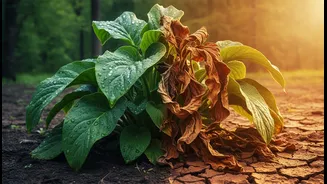

When Rainforests Run Dry
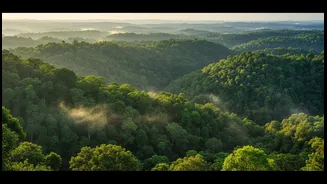
Tropical rainforests, the planet's verdant lungs, are increasingly gasping for water. Once defined by their predictable, abundant rainfall, these ecosystems are now facing longer, hotter, and more frequent droughts. This isn't a distant future problem;
it's a present-day crisis unfolding in critical regions from the Amazon to Southeast Asia. The combination of extreme heat and lack of water puts immense stress on forests unaccustomed to such conditions. When the soil dries and the air becomes a sponge for moisture, the very system that keeps a forest alive begins to break down, threatening trees that have stood for centuries. This shift is forcing scientists and conservationists to ask an urgent question: how do these complex ecosystems respond when their most fundamental resource vanishes?
A Tale of Two Strategies
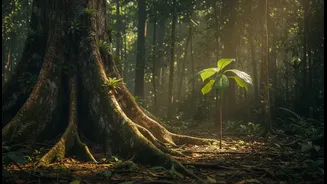
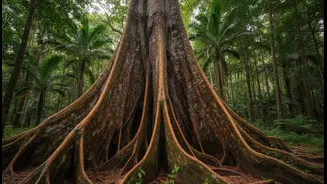
In a forest, a tree's place in the sun is often determined by its height. Towering canopy trees, reaching for the sky, have unparalleled access to sunlight but are also exposed to the harshest elements—scorching sun and drying winds. Below them, the smaller trees of the understory live a more sheltered life, but must compete for trickles of light in the shade. Conventional wisdom suggested that the tallest trees were the most vulnerable to drought; after all, they have the immense challenge of pulling water dozens of metres into the air against gravity. This physical feat makes their hydraulic systems, the network of xylem that acts like plumbing, seemingly more susceptible to failure. Smaller trees, with less distance to cover, were thought to have an advantage. The reality, however, is far more complicated.
Shared Vulnerability, Different Fates
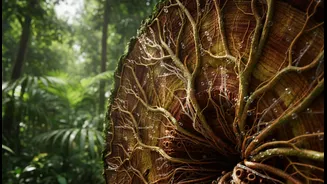
While their circumstances differ, all trees share a fundamental vulnerability: they can die of thirst. During a drought, the tension on the water column inside a tree's xylem can become so great that air bubbles form, causing a deadly embolism—the equivalent of a heart attack for a tree's water transport system. This is known as hydraulic failure. Taller trees were long assumed to be most at risk of this. However, some recent studies show that the tallest tropical trees have developed remarkable adaptations, such as wider vessels at their base, to move water more efficiently and cope with water stress. In some cases, both tall and short trees are affected by drought in similar ways, though through different mechanisms. A small tree might die not from hydraulic failure, but from starvation. To conserve water, it closes the pores on its leaves (stomata), which stops it from taking in the carbon dioxide needed for photosynthesis, effectively starving itself over time. So while the cause of death may differ, the threat is universal.
Complex Local Differences
A tree's fate is not sealed by its height alone. A complex web of local factors creates a mosaic of vulnerability. The specific species of a tree matters immensely, as some are naturally more drought-tolerant than others. The soil itself plays a crucial role; a forest on sandy soil will respond to a lack of rain very differently than one on clay, which can hold moisture longer. Furthermore, topography is key. Trees on exposed ridges face tougher conditions than those in sheltered valleys where water might collect. These intricate local differences explain why, during a drought, you might see one tree wither while its neighbour of a different species, or even a larger tree of the same species, appears to survive. There is no single rule, highlighting the challenge for conservation.
Lessons for India's Green Canopies
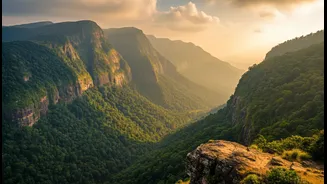
These global findings have direct relevance for India, where diverse tropical forests, from the wet evergreen forests of the Western Ghats to the dry deciduous forests of the central plateau, are already facing the double threat of extreme heat and drought. Studies in India have shown that these events can lead to significant reductions in forest growth and even trigger widespread tree mortality, potentially shifting entire ecosystems toward drier, savanna-like states. Understanding that tall and small trees have different vulnerabilities is critical. A conservation plan that only focuses on, for example, planting fast-growing tall trees might neglect the crucial role and unique risks faced by the understory. Effective forest management in a changing climate requires a nuanced approach that considers the entire structure of the forest, from the soil to the canopy, and acknowledges the different survival strategies of all its inhabitants.