

A Galaxy Flipped on Its Head
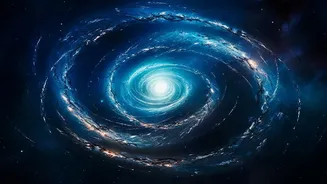
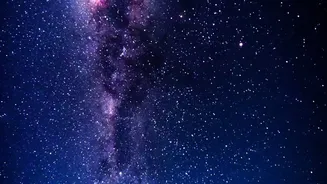
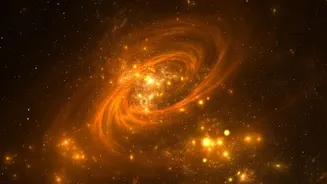
Imagine our entire galaxy, a sprawling disc of a hundred billion stars, flipping over. It sounds like science fiction, but recent findings suggest this may have actually happened in the Milky Way's distant past. Astronomers from Durham University presented
research in July 2026 showing that a massive, head-on collision with another galaxy likely caused our galaxy's entire disc to change its orientation by more than 90 degrees. This research, presented at the National Astronomy Meeting, uses supercomputer simulations to explain one of the Milky Way’s most puzzling features: a slowly rotating stellar halo. The stellar halo is a vast, ghostly sphere of old stars surrounding the main galactic disc. Its slow spin has been a long-standing mystery, and this new “disc flip” theory provides a compelling explanation.
Echoes of a Cosmic Crash
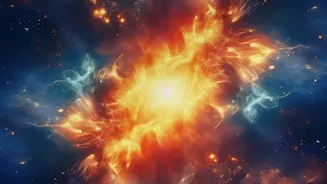
The culprit behind this galactic upheaval was a major merger with a galaxy known as Gaia-Sausage-Enceladus, which slammed into our own about 10 billion years ago. Evidence for this ancient collision has been building for years, thanks to data from the European Space Agency's Gaia mission, which has been meticulously mapping the stars. Gaia uncovered a group of stars moving on strange, elongated paths opposite to the flow of most other stars in our galaxy, the tell-tale debris from this cosmic pile-up. The new simulations show that such a significant, head-on merger is precisely the kind of event that could provide the force needed to flip the entire galactic disc. According to the research, this means that most of the stars we see today, possibly even our own Sun, were once on completely different trajectories.
The Technology Behind the Discovery
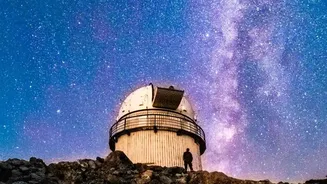
These breakthroughs wouldn't be possible without a combination of advanced simulations and next-generation telescopes. While supercomputers run complex models to test theories about galactic evolution, telescopes like the James Webb Space Telescope (JWST) and the Very Large Telescope (VLT) provide the hard data. The JWST, for instance, is peering into the early universe, discovering how the very first galaxies formed and filled the cosmos with the stardust needed for later generations of stars. Meanwhile, ground-based observatories like the VLT in Chile can track the subtle movements of individual stars around the Milky Way's core, providing crucial tests for theories from Albert Einstein's General Relativity to the nature of galactic halos. These instruments work in tandem, allowing astronomers to piece together a story that spans billions of years.
Redefining the Galactic Edge
Other new discoveries are refining our map of the Milky Way right now. In April 2026, astronomers announced they had finally pinpointed the true 'edge' of the galaxy's star-forming region. It turns out that star birth drops off sharply about 40,000 light-years from the galactic center. Using a technique called stellar “age mapping,” scientists found that stars beyond this boundary are not newly formed but are migrants that have drifted outward over time. This provides a clear, quantitative answer to where our galaxy’s stellar nursery ends. This discovery complements the story of our galaxy's violent past, showing how dynamic processes continue to shape the Milky Way on both large and small scales, from massive flips to the slow drift of stars at its outer edge.
New Clues to Dark Matter
Unraveling the history of the Milky Way's visible components also provides hints about the invisible universe. The Durham University study found that the rotation of the stellar halo is closely linked to the rotation of the galaxy's dark matter halo. This suggests the two evolved together as the galaxy grew by consuming smaller ones. Dark matter, which makes up most of the universe's mass, cannot be seen directly, so its structure must be inferred from the movements of stars and gas. By understanding how a massive collision could flip the stellar disc, scientists gain a new tool to indirectly probe the shape and behavior of the dark matter that surrounds and permeates our galaxy, offering a richer picture of the cosmic web.