




Cosmic Lighthouses and Their Hazy Glow
When a massive star dies, it doesn't always go quietly. After a spectacular supernova explosion, it can leave behind a bizarre remnant: a neutron star. These objects are cosmic marvels, packing more mass than our sun into a sphere the size of a city.
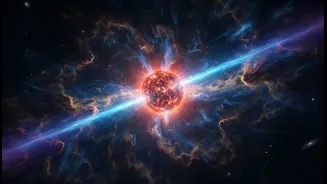
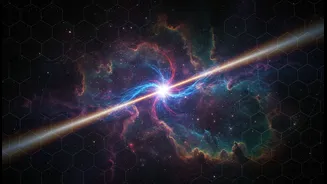
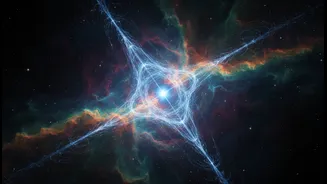
Some of these neutron stars are pulsars, which spin at incredible speeds and sweep beams of energy across the galaxy like a lighthouse. This powerful rotation and intense magnetic field generate a constant outflow of charged particles, known as a pulsar wind. This wind slams into the surrounding interstellar gas and debris from the initial supernova, creating a vast, glowing structure called a pulsar wind nebula. For decades, the Crab Nebula has been our primary textbook example, a beautiful and complex cloud powered by the pulsar at its heart.
Mapping the Invisible
The headline's "Lighthouse Pulsar Map" isn't a single chart, but rather a new way of seeing these objects thanks to advanced instruments like NASA's Neutron star Interior Composition Explorer (NICER) and the Imaging X-ray Polarimetry Explorer (IXPE). NICER, mounted on the International Space Station, can time the arrival of X-rays from pulsars with nanosecond precision. This allows scientists to map the hot spots on a pulsar's surface—the sources of the lighthouse beams. IXPE, on the other hand, measures the polarization of X-rays, which reveals the direction and structure of the magnetic fields that shape these nebulae. By combining data from these instruments, astronomers can build unprecedented models of not just the pulsar itself, but the entire system it influences.
The Old Picture: A Simple Cosmic Engine
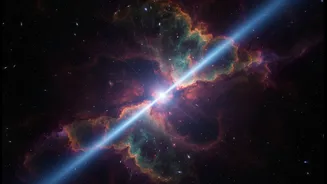
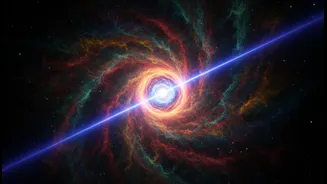
For a long time, the standard model of a pulsar was relatively simple: a spinning sphere with a magnetic field like a bar magnet, featuring two hot spots at opposite poles. These spots would sweep around, creating the regular pulses we observe. The winds flowing from these poles were thought to expand out more or less uniformly, creating a predictable, bubble-like nebula around the pulsar. While elegant, this model couldn't explain the strange shapes and complex features seen in many pulsar wind nebulae, such as the long, thin filament of the 'Lighthouse Nebula' (officially known as PSR J1101-6101). It was clear something was missing from our understanding of how these powerful stellar engines work.
A New, More Complicated Reality
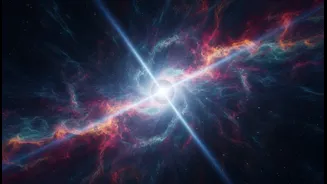
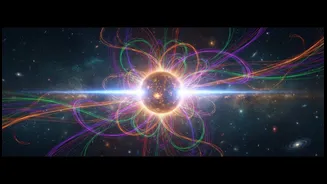
NICER's surface maps of pulsars like J0030 have already delivered a shock to the system. Instead of two neat hot spots at the poles, it found a more chaotic arrangement, with multiple spots of different shapes and sizes clustered in one hemisphere. This discovery completely upends the simple 'bar magnet' model and suggests the magnetic fields on the surface are far more tangled and complex than ever imagined. This, in turn, has huge implications for the pulsar winds they generate. A more complicated magnetic field means the wind isn't a uniform outflow. Instead, it's likely a gusty, structured torrent of particles, with jets and streams flowing in specific directions. Recent IXPE observations of the Lighthouse Nebula confirmed this, showing that particles were escaping the pulsar and flowing along the galaxy's broader magnetic field lines, creating the nebula's needle-like shape.
Changing Our View of Cosmic Winds
This new understanding transforms how we see pulsar wind nebulae. They aren't just passive bubbles of gas; they are active laboratories for extreme physics, sculpted by complex, directed winds. The shape of a nebula can tell us about the pulsar's orientation, its history, and the structure of its magnetic field. For instance, the unexpectedly high degree of magnetic alignment in the Lighthouse Nebula's filament challenges existing models of turbulence and particle acceleration. It suggests that particles might be accelerated in different ways depending on their energy, a clue that could help solve long-standing mysteries about how cosmic rays—highly energetic particles that bombard Earth from space—are created. By studying these winds, scientists can probe the interaction between the most extreme objects in the universe and their environments.