


First, What Is a Biosignature?
Think of a biosignature as a fingerprint left behind by life. It’s not necessarily a living creature, but any substance, object, or pattern that provides evidence of biological processes. On Earth, the oxygen we breathe is a powerful biosignature; it’s
overwhelmingly produced by photosynthesis. Other potential signs include gases like methane or the presence of complex organic molecules. Scientists aren't just looking for one specific thing, but rather a collection of clues that, when viewed together, point strongly toward a biological origin. This can range from gases in an atmosphere to specific mineral patterns or even pigments on a planet's surface.
The Universe Is a Noisy Place
The main problem is that many things can create 'false positives'—signals that look like life but aren't. A planet’s atmosphere is a complex chemical factory. Volcanoes can spew out gases like sulfur dioxide, and geological reactions can produce methane. Even starlight can break down molecules like water to create oxygen abiotically, without any life involved. This non-biological 'noise' makes it incredibly difficult to be certain about a discovery. Scientists must act like cosmic detectives, painstakingly ruling out every possible non-living explanation before they can even begin to suggest life as a possibility.
The Planetary Detective's Toolkit
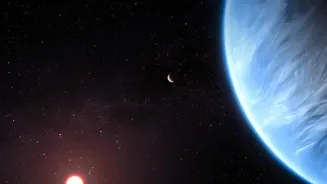
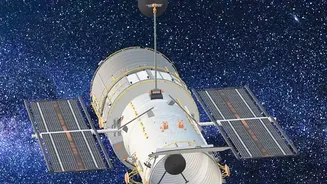
The primary tool for this detective work is spectroscopy. Using powerful instruments like the James Webb Space Telescope (JWST), scientists can analyze the light from a distant star as it passes through an exoplanet's atmosphere. As the light shines through, different gases absorb specific colours, or wavelengths, of that light. This creates a unique barcode-like pattern, called a spectrum, that reveals which chemicals are present. JWST is sensitive enough to detect minute traces of gases in the atmospheres of planets light-years away, giving us our first real opportunity to catalogue the atmospheric ingredients of other worlds.
It's All About the Right Combination
Finding a single gas, even oxygen, is not enough to prove life exists. The key is context and looking for chemical imbalances. For example, finding methane and oxygen in the same atmosphere would be incredibly exciting. On their own, these two gases react and destroy each other. For both to be present in large quantities, something would need to be constantly replenishing them. On Earth, that 'something' is life—photosynthesis producing oxygen and microbial life producing methane. Finding such a contradictory mix on another planet would be a powerful indication that some active, life-like process is at work.
Building a Case for Life
Ultimately, claiming the discovery of extraterrestrial life won't be a single 'Eureka!' moment. It will be a slow, methodical process of building a case with multiple lines of evidence. Scientists need to observe a planet over time, perhaps looking for seasonal changes in gases that could indicate a planetary-scale biosphere. They will use complex computer models to simulate the planet’s environment and test whether any known non-biological process could explain their observations. Only when all other possibilities are exhausted, and the evidence from multiple sources points in the same direction, will the scientific community gain confidence that we might have found a true biosignature.