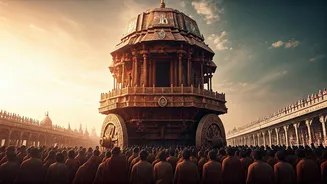










What Exactly Is a Rath Yatra?
At its heart, a Rath Yatra, or chariot festival, is a Hindu procession where deities are taken from their temple sanctum and paraded through the streets in a massive, ornate chariot (the rath). The most famous of these is the Puri Jagannath Rath Yatra in Odisha,
a UNESCO-recognised event with centuries of history. Here, the sibling deities—Jagannath (a form of Vishnu), Balabhadra, and Subhadra—leave the confines of their majestic temple for a nine-day sojourn to their 'aunt’s house', the Gundicha Temple. The core idea is profoundly democratic: the gods, who are normally accessible only to priests inside the temple, come out to see and be seen by everyone, regardless of caste or creed. It’s divinity made mobile and accessible to the masses.
The Architecture of Devotion
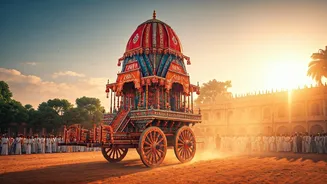
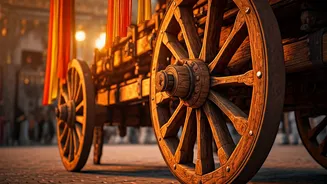
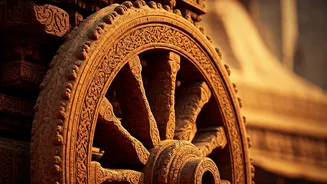
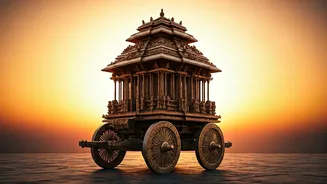
The term 'chariot' hardly does justice to these structures. The three chariots of Puri, for instance, are monumental undertakings. Jagannath’s chariot, Nandighosha, stands over 44 feet tall, with 16 massive wheels. They are constructed fresh each year from specific types of wood by a dedicated community of artisans, following ancient traditions passed down through generations. These are not merely vehicles; they are temporary temples on wheels, covered in intricate carvings, painted with symbolic motifs, and draped in tonnes of fabric. The sheer scale, engineering, and artistry involved in creating these temporary marvels are a testament to the resources—both material and human—that communities pour into this act of devotion. It's a display of craftsmanship powered by unwavering faith.
A Symphony of Community and Belief
A Rath Yatra is nothing without its people. Millions of devotees converge, not just as spectators but as active participants. The most potent symbol of this is the act of pulling the chariots. Thick coir ropes, often hundreds of metres long, are grasped by thousands of hands. To pull the rath is considered an act of immense piety, a way to directly serve the divine. The energy is electric. It’s a physical, sweaty, and overwhelming expression of collective spiritual labour. This shared effort dissolves individual identities into a single, pulsing sea of humanity, united by a common purpose. The festival is also a massive economic engine, supporting artisans, priests, vendors, and the local tourism industry, weaving the sacred and the profane into a single, vibrant tapestry.
So, Why Is It a 'Flex'?
In an age of digital identities and fleeting online trends, the Rath Yatra is an unapologetically physical, loud, and public declaration of belief. This is where the 'flex' comes in. It’s a flex of numbers: the sheer mass of people demonstrates the living power of the faith. It’s a flex of resources: the wealth, time, and skill invested are immense. It’s a flex of tradition: it showcases the continuity of a ritual over centuries, adapting but not diminishing. And most importantly, it’s a flex of space. The procession temporarily reclaims public thoroughfares for a sacred purpose, transforming the mundane cityscape into a divine pathway. In modern India, where public life is a constant negotiation, the Rath Yatra is a powerful, peaceful assertion of cultural and spiritual identity on a scale that cannot be ignored.
From Puri to the Planet
While Puri remains the epicentre, the Rath Yatra is not a monolithic event. Thousands of smaller chariot festivals happen across India, dedicated to various local deities, each with its own unique flavour and customs, especially prominent in states like Tamil Nadu and West Bengal. Furthermore, thanks to the efforts of organisations like ISKCON (International Society for Krishna Consciousness), the Rath Yatra has gone global. Chariots roll down the streets of London, New York, and Sydney, introducing the spectacle of devotion to new audiences. This globalisation has turned a distinctly Indian tradition into a worldwide phenomenon, further amplifying its reach and making it a powerful tool of cultural diplomacy and spiritual outreach.