



Meet the Peculiar Galaxy
First, let's get acquainted with the subject. Centaurus A, also known as NGC 5128, is a galaxy located about 11 to 13 million light-years from Earth—a close neighbour in cosmic terms. For years, astronomers have been fascinated by its strange appearance.
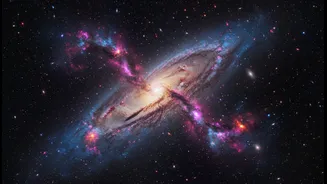
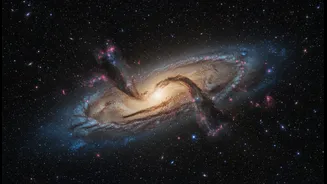
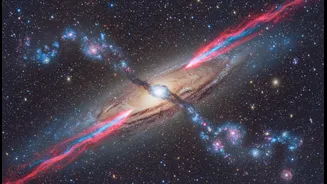
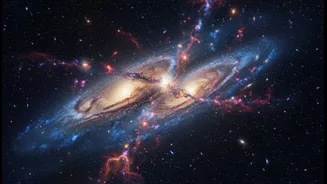
It looks like a giant, smooth elliptical galaxy that has been sliced in half by a thick, dark band of cosmic dust. This unusual structure is the biggest clue to its violent past. Scientists now know that Centaurus A is the product of a massive collision between a large elliptical galaxy and a smaller spiral galaxy that it consumed roughly two billion years ago. The dramatic dust lane we see is the twisted wreckage of the smaller galaxy, its contents being churned and assimilated.
Why Webb's View Is a Game-Changer
Previous powerful telescopes like the Hubble Space Telescope gave us stunning views of Centaurus A in visible light. However, that prominent dust lane acted like a thick curtain, blocking our view of the galaxy's core. We knew something was happening behind it, but we couldn’t see the details. This is where the James Webb Space Telescope's magic comes in. Webb is designed to see the universe in infrared light, which can pass through dense clouds of dust that visible light cannot. While NASA's retired Spitzer Space Telescope also saw in infrared, it lacked the sharpness to resolve fine details. Webb combines both clarity and depth, allowing astronomers to pierce the veil of dust and see the intricate processes happening within the galaxy's heart, star by individual star.
A Portrait of Cosmic Violence
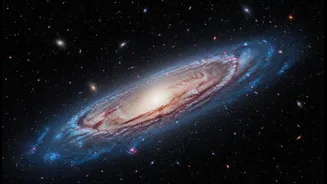
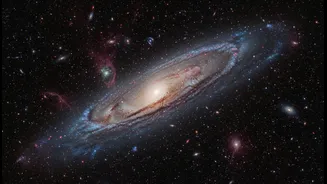
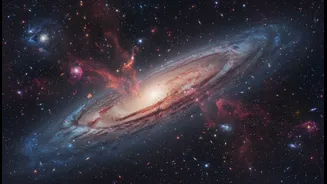
So, what exactly do Webb's new images show? They reveal the aftermath of the collision in unprecedented detail. The dark dust lane is transformed into glowing, intricate filaments and mottled clouds of gas and dust. We can see a warped, parallelogram-like structure at the centre, evidence of the gravitational turmoil from the merger. These glowing regions are stellar nurseries, where the shockwaves from the collision have compressed gas and dust, triggering a massive burst of new star formation. What might look like a grainy texture in the images is actually a dense field of millions of individual stars, each a data point that helps astronomers perform a kind of galactic archaeology, piecing together the timeline of this ancient crash.
The Monster in the Middle
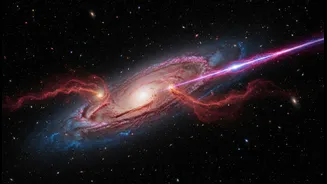
At the very heart of Centaurus A lies another key player: a supermassive black hole with a mass of about 55 million times that of our sun. The galactic merger is actively feeding this beast, funnelling a steady stream of gas and dust towards it. As the black hole consumes this material, it doesn't do so quietly. It blasts out powerful, high-speed jets of energy and particles that travel for thousands, even millions, of light-years. Webb's observations reveal the complex relationship between this active black hole and its host galaxy. The black hole’s energetic output can compress gas to create new stars, but it can also blow away the raw material, effectively shutting down star formation. This cosmic interplay is fundamental to understanding how galaxies and their central black holes grow and evolve together.