
The Sun's Volatile Temper
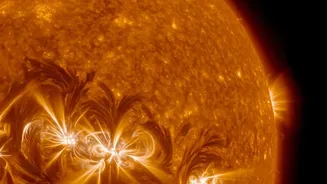
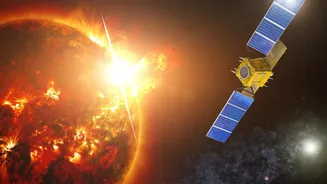
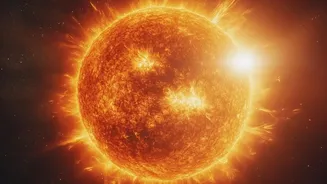
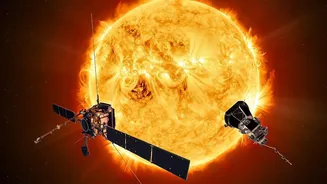
The Sun, our life-giving star, has a volatile side. It periodically unleashes massive explosions of energy and matter. The two main types of events that concern us are solar flares and coronal mass ejections (CMEs). A solar flare is an intense burst of radiation,
an explosion on the Sun's surface that can reach Earth in just eight minutes. A CME, on the other hand, is a colossal bubble of plasma and magnetic field that gets hurled into space, sometimes toward Earth. While often associated, they are distinct phenomena; flares are the bright flash, while CMEs are the giant cloud of material that follows, typically taking one to three days to cross the 150 million kilometres to our planet. When a CME ploughs through space, its shockwave can accelerate solar particles to near light speed, creating a surge of energetic particles.
Why Space Assets Are at Risk
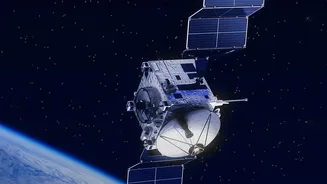
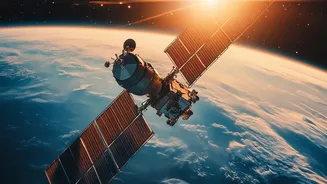
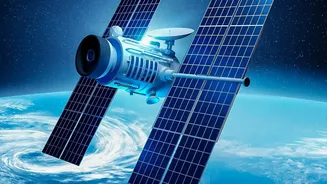
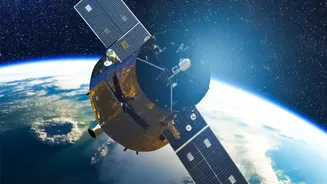
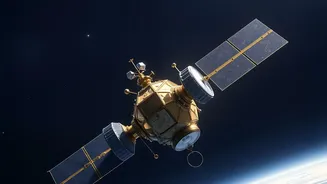
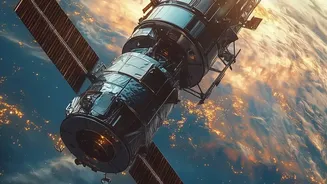
Space-based assets, particularly satellites in high orbits, operate beyond the full protection of Earth's atmosphere and magnetic field. This leaves them vulnerable to these solar outbursts. Energetic particles, mostly protons, are like microscopic cannonballs that can penetrate a satellite's shielding. They can damage sensitive electronics, causing 'phantom commands' or system errors that might make a satellite tumble. Over time, this radiation degrades solar panels, effectively shortening a satellite's operational lifespan. Furthermore, a powerful CME can compress Earth's magnetic field, creating a geomagnetic storm. This can heat and expand the upper atmosphere, increasing the drag on low-Earth orbit (LEO) satellites and causing them to lose altitude, risking collisions. The economic cost of losing even one of these complex machines, vital for telecommunications, navigation, and weather forecasting, can be enormous.
The Digital Shield: How Simulations Work
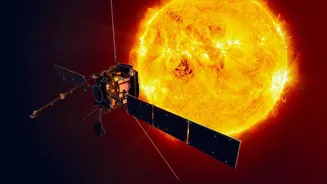
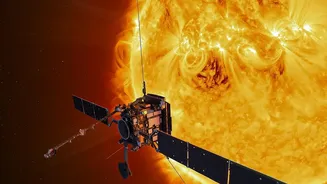
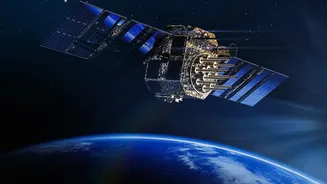
This is where advanced simulations come in. Forecasters at institutions like NOAA's Space Weather Prediction Center (SWPC) and NASA can't stop a CME, but they can predict its path and intensity. The process begins with observation. Satellites like the Geostationary Operational Environmental Satellites (GOES) and the Deep Space Climate Observatory (DSCOVR) constantly monitor the Sun. DSCOVR, positioned at a gravitationally stable point between the Earth and Sun, acts as an early warning buoy, detecting changes in the solar wind. This real-time data is fed into complex physics-based computer models. The WSA-Enlil model, for example, is a large-scale simulation of the heliosphere. It takes data on a CME's launch from the Sun and models its journey through space, predicting its arrival time at Earth and its likely severity. These mathematical models essentially create a weather forecast for the space between the Sun and our planet.
From Prediction to Protection
A forecast is only useful if you act on it. A warning from the SWPC can give satellite operators one to three days of lead time before a CME's impact. This critical window allows them to take protective measures. For instance, operators can put a satellite into 'safe mode,' powering down non-essential and sensitive instruments to reduce the risk of electrical damage. They can also reorient the spacecraft to ensure its most shielded parts face the incoming particle storm, much like turning your back to a strong wind. For satellites in low-Earth orbit, operators might choose to delay manoeuvres or prepare to make orbit-correction burns to counteract the effects of increased atmospheric drag. It is a proactive defence strategy that transforms a forecast into tangible protection for multi-million dollar assets.
The Future of Space Weather Forecasting
The field of space weather prediction is constantly evolving. Researchers are working to improve the accuracy and lead time of their forecasts. This involves developing next-generation models that can better represent the complex magnetic structures within the Sun's corona, which are the root cause of these eruptions. New open-source modelling frameworks, like 'Aether', aim to create a more collaborative environment for researchers to refine and improve prediction capabilities. By combining data from an array of spacecraft with increasingly sophisticated computer models, scientists hope to provide more precise warnings. The goal is to move from predicting that a storm is coming to specifying exactly which regions and systems will be most affected, allowing for even more targeted and effective protective actions.