


A Cosmic Game of Hide-and-Seek
Before you can study a planet's atmosphere, you first have to find the planet. Scientists do this using the 'transit method,' which is a bit like spotting a fly passing in front of a bright lamp. When an exoplanet passes in front of its host star from
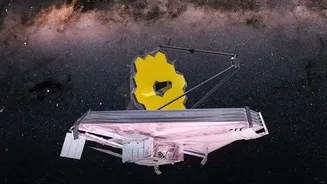
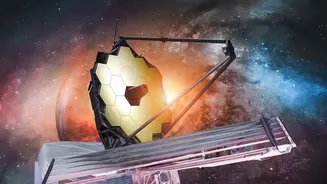
our point of view, it causes a tiny, temporary dip in the star's brightness. By observing these dips repeatedly, astronomers can confirm the planet's existence and even calculate its size and orbit. The James Webb Space Telescope is exceptionally good at this, capable of detecting the minuscule changes in light caused by even small, rocky worlds many light-years from Earth.
The Power of Infrared Vision
The real magic of the JWST lies in its ability to see the universe in infrared light, which is invisible to the human eye. This is crucial for two reasons. First, many of the most interesting molecules that could indicate a life-supporting atmosphere—like water vapour, methane, and carbon dioxide—leave their most obvious chemical fingerprints in the infrared part of the light spectrum. Second, observing in infrared allows the telescope to peer through cosmic dust and focus on a planet's atmosphere with incredible clarity. Instruments like the Near-Infrared Spectrograph (NIRSpec) and Mid-Infrared Instrument (MIRI) are specifically designed to capture this light with unparalleled sensitivity.
Reading an Atmospheric Barcode
This is where the detective work truly begins. As the planet transits its star, a tiny fraction of the starlight filters through the planet’s atmosphere on its way to the telescope. The gases in that atmosphere absorb specific wavelengths, or colours, of the light. Each chemical element and molecule has a unique absorption pattern, like a barcode. JWST’s spectrographs split the incoming starlight into its full rainbow of colours, revealing which parts are missing. By analysing this 'transmission spectrum,' scientists can identify exactly what gases are present in the planet's air, offering clues about its temperature, density, and composition.
Clues from a Lava World
One of the most stunning early successes for this technique came from a 'super-Earth' named 55 Cancri e. This rocky planet orbits so close to its star that its surface is likely a molten ocean of magma. Logic suggested that any atmosphere should have been blasted away long ago. But JWST detected the best evidence to date of an atmosphere on a rocky exoplanet. The temperature was cooler than expected for bare rock, implying that an atmosphere, likely rich in carbon dioxide or carbon monoxide, is distributing heat around the planet. Scientists believe this is a 'secondary' atmosphere, constantly being replenished by gases bubbling out of the magma ocean below, challenging old theories about planetary survival.
A Breakthrough in the Habitable Zone
While lava worlds are fascinating, the ultimate goal is to find atmospheres on planets in the 'habitable zone,' where liquid water could exist. The TRAPPIST-1 system, with seven rocky planets, has been a prime target, but early results showed the innermost planets to be bare rocks. However, in mid-2026, scientists announced a landmark discovery around a different planet: LHS 1140 b. They detected helium escaping from this rocky world, which lies squarely in its star's habitable zone. This is the first strong sign of an atmosphere on such a world and proves that planets orbiting active red dwarf stars can indeed hold onto their air, dramatically widening the search for potentially habitable planets.