

A New Polygon in the Clouds
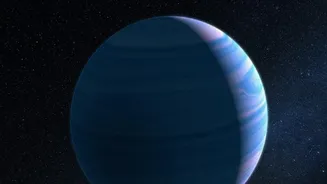
Recent observations from the Hubble Space Telescope have confirmed the existence of a massive, 10-sided atmospheric feature, or 'decagon,' swirling around Saturn's south pole. This isn't a solid structure, but a giant, persistent wave within one of the planet's
powerful jet streams. The discovery marks the first time such a regular, multi-sided weather pattern has been observed in Saturn's southern hemisphere. For years, scientists have known about the bizarre six-sided hexagon at the north pole, a feature so stable it has been observed for over 40 years. This new decagon, however, appears to be a much more recent development. Data shows it began to emerge as early as 2023 and has become more defined in subsequent images, giving scientists an unprecedented opportunity to watch a giant planetary weather system form in real time.
A Glimpse Enabled by the Seasons
The reason this discovery is happening now is tied directly to Saturn's epic seasons. The gas giant takes a staggering 29 Earth years to complete one orbit around the sun, meaning each of its seasons lasts for more than seven years. For a long period, Saturn's axial tilt kept its south pole angled away from Earth, hidden from our telescopes. The Cassini spacecraft, which orbited Saturn from 2004 to 2017, never saw a hint of this structure. It was only as Saturn’s southern hemisphere began tilting back toward us in 2023 that the pole came into view again. This long-awaited peek allowed both ground-based observers and, ultimately, the sharp-eyed Hubble to spot the developing pattern. The “rare look” in the headline is quite literal; it’s a view astronomers have been waiting years to get.
The Tale of Two Poles
The existence of the southern decagon raises fascinating questions, primarily by contrasting it with its northern counterpart. The northern hexagon is a picture of stability, a fixture of the planet’s atmosphere since it was first seen by the Voyager probes in the 1980s. The southern decagon, on the other hand, appears to be dynamic and evolving. This puzzles scientists. “The northern hexagon has been there every time we’ve looked for more than 40 years,” noted Amy Simon, a planetary scientist at NASA's Goddard Space Center. “This feature is different — it appears to be strengthening.” Why did this pattern form now? Why is it a decagon and not another hexagon? Understanding the differences between these two polar vortices could unlock new insights into the underlying physics that govern the atmospheres of gas giants.
Hubble’s Enduring Vigil
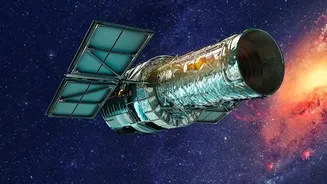
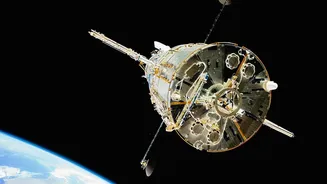
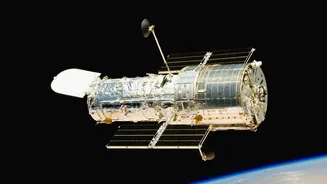
This discovery underscores the unique and irreplaceable role of the Hubble Space Telescope. While newer telescopes like JWST offer incredible power, Hubble's strength lies in its long-term, consistent observation of the solar system in specific light wavelengths. This discovery was made possible by the Outer Planet Atmospheres Legacy (OPAL) program, which uses Hubble to conduct an annual health check on our solar system's outer planets. By piecing together several years of these OPAL observations, researchers were able to confirm the decagon's existence and trace its evolution. It's a testament to the power of a patient, persistent eye in the sky. Without Hubble’s steady vigil, this fleeting and formative moment in Saturn’s atmospheric life might have been missed entirely.