


More Than Just Hiding
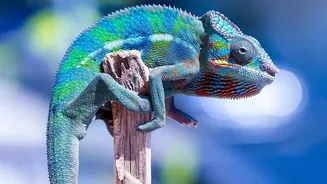
The idea of a chameleon seamlessly blending into a plaid shirt is a fun cartoon gag, but it's largely a myth. While their natural green and brown hues offer excellent camouflage in their native leafy habitats, this is more of a default setting than an active
choice. Studies have shown some species can subtly adjust their brightness to better match their background and avoid predators, but this is a far cry from the active, conscious mimicry we often imagine. In fact, their most dramatic and rapid colour changes often make them more visible, not less. This is because the primary drivers for these stunning transformations aren't about hiding from the world, but about sending a clear message to it.
A Vivid Social Language
A chameleon's skin is a living billboard, broadcasting its mood, intentions, and social status to other chameleons. This is their primary form of communication. A male looking to court a female might flash his most vibrant and attractive colours, much like a bouquet of flowers. If he spots a rival male, those same bright colours become war paint, a signal of aggression and dominance meant to intimidate the competitor into backing down. The weaker male will often signal submission by returning to a more neutral, dull colour. Females have their own palette to communicate whether they are receptive to mating or are already carrying eggs. A stressed or frightened chameleon might turn a very dark, almost black colour, while a relaxed and content one will display lighter, calmer tones. It's a complex and nuanced language, all spoken through the skin.
A Personal Thermostat
As cold-blooded, or ectothermic, animals, chameleons rely on external sources to regulate their body temperature. Their colour-changing ability is a crucial tool for this. On a cool morning, a chameleon might darken its skin to absorb more heat and energy from the sun. As the day gets hotter, it will shift to a much lighter colour to reflect sunlight and prevent overheating. This passive thermoregulation is vital for their survival, allowing them to maintain an optimal body temperature in fluctuating climates. So, a dark chameleon might not be angry or scared; it could simply be trying to warm up.
How The Magic Happens
This incredible ability isn't due to pigments in the way you might think. Unlike squids, which disperse pigments, chameleons have layers of specialized skin cells called iridophores. These cells contain tiny, tunable nanocrystals of guanine. By exciting or relaxing their skin, chameleons can change the physical spacing between these crystals. When the crystals are packed tightly together, they reflect shorter wavelengths of light, like blue. When they are spaced farther apart, they reflect longer wavelengths, like yellows and reds. A deeper layer of cells containing dark melanin can also influence the brightness of the colours. This remarkable system allows for rapid and reversible colour changes in response to the chameleon's mood or temperature, all within a matter of minutes.