


More Than Just a Colour
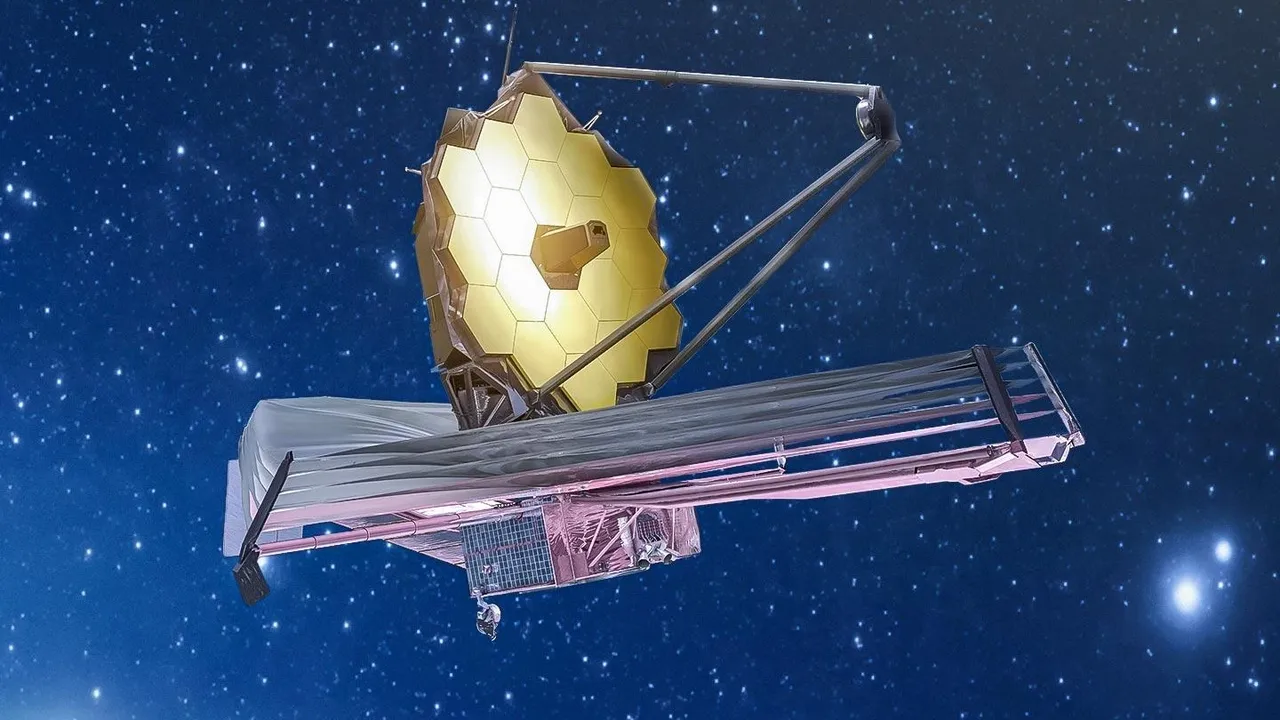
When astronomers point a telescope at the distant universe, they are also looking back in time. The light from the most remote objects has travelled for billions of years to reach us. As it crosses the expanding cosmos, its wavelength gets stretched out,
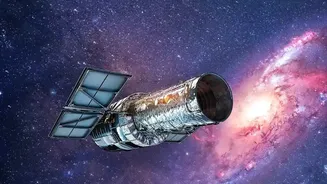
shifting it towards the red end of the spectrum in a process called 'redshift'. This is why the most ancient objects Webb sees often appear red. Since the telescope began operations in 2022, it has identified hundreds of these 'little red dots' (LRDs). They appear to have existed in a specific window of cosmic history, emerging around 600 million years after the Big Bang and then fading from view about a billion years later. Initially, their nature was a complete mystery, sparking a race to understand what they were.
A Cosmic Identity Crisis
Early theories proposed two extraordinary possibilities. One idea was that LRDs were incredibly dense, dusty galaxies forming stars at a furious rate. The problem with this theory was their implied mass. Some appeared to be more massive than our own Milky Way, which shouldn't be possible so early in the universe's history when there simply wasn't enough material available. This contradiction led some to cheekily claim the discoveries were 'breaking cosmology'. The alternative theory was that these dots were not galaxies at all, but something even more exotic: the glowing hearts of ravenously hungry supermassive black holes. In this scenario, the red colour comes from light being emitted from a dense cocoon of gas and dust being superheated as it's devoured by the black hole.
Solving the Puzzle, Piece by Piece
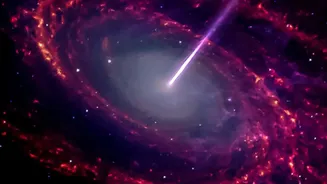
Recent studies have provided the strongest evidence yet that the black hole theory is correct. One team focused on a little red dot designated GLIMPSE-17775, seen as it was about 1.8 billion years after the Big Bang. Using Webb's powerful spectrographs, which break down light into its component parts, they found multiple signs of a supermassive black hole actively feeding. The light signature showed emissions from superheated gas and elements that don't align with star formation, but perfectly match models of a growing black hole cloaked in a dense shroud of gas. Essentially, these LRDs are not just galaxies; they are active galactic nuclei (AGN), a phase where the central black hole is shining so brightly it outshines its entire host galaxy.
Rewriting the Story of Black Holes
This discovery changes our understanding of the early universe. It suggests that supermassive black holes could form and grow much faster than previously believed. Rather than starting as small seeds from collapsed stars and growing slowly, it appears some may have started as 'heavy seeds' or formed through direct collapse, allowing them to become enormous in a very short amount of cosmic time. The LRDs represent a key, temporary phase in this growth. They are so bright and active in the early universe, but as the black holes consume the nearby gas and dust or blow it away, their appearance changes, and they evolve into the more familiar, less shrouded galaxies we see in the later universe. This helps explain why LRDs seem to disappear as the cosmos matures. The simple red dot is actually a snapshot of a crucial, fleeting stage of cosmic evolution.