



An Ever-Growing Tally
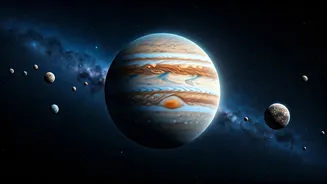
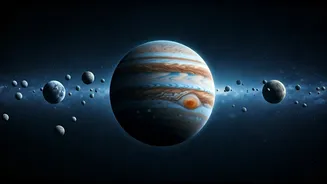
The headline-making number of “over ninety” is actually an understatement that points to a rapidly changing reality. As of early 2026, the official count of Jupiter's known moons has soared past 100, with some astronomical bodies citing as many as 115.
[1, 8] This isn't a case of scientists getting their numbers wrong; it's a testament to how quickly our technology is improving. New discoveries are constantly being made and confirmed. Astronomers using powerful telescopes in Chile and Hawaii are regularly spotting faint, previously unseen objects. [3] Each one must be observed over time to confirm its orbit before it can officially be declared a moon and added to the list kept by the International Astronomical Union's Minor Planet Center. [2, 11] So, while the exact number is a moving target, one thing is certain: Jupiter has the most crowded satellite system in our solar system. [7, 11]
A Family of Misfits and Giants
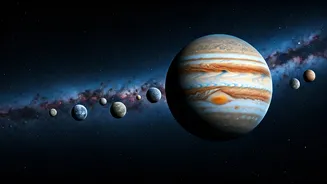
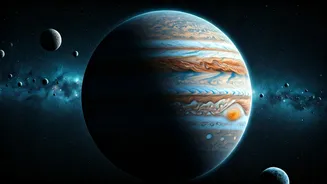
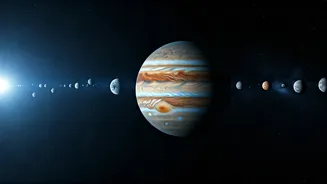
Jupiter’s moons are not a uniform bunch. They are broadly divided into two main categories: regular and irregular. The eight regular satellites orbit in neat, nearly circular paths close to Jupiter's equatorial plane. [1] This group includes the four stars of the show: the Galilean moons, discovered by Galileo Galilei in 1610. [1, 7, 10] These four—Io, Europa, Ganymede, and Callisto—are so large they would be considered planets if they orbited the sun on their own. [1, 6] Ganymede is even larger than the planet Mercury. [6] Together, these four giants contain about 99.997% of the total mass orbiting Jupiter. [1] The vast majority of the other moons are tiny by comparison, often just a few kilometers across. [15]
The Irregular Swarm: Echoes of a Violent Past
Beyond the tidy orbits of the regular moons lies a chaotic swarm of over 100 irregular satellites. [1] These are small, oddly shaped bodies with distant, highly inclined, and often retrograde orbits, meaning they travel in the opposite direction of Jupiter's rotation. [1, 4, 18] Astronomers believe these are not moons that formed alongside Jupiter but are instead captured asteroids and comets that were pulled in by the planet's immense gravity billions of years ago. [14, 18] Many of these irregulars are grouped into families that share similar orbits, suggesting they are fragments of larger bodies that were shattered by collisions long ago. [1, 12] Studying these broken families gives scientists a fascinating glimpse into the violent and chaotic early history of our solar system.
How a Moon Gets Its Name
The first four moons were named by astronomer Simon Marius for lovers and figures associated with the Greek god Zeus—the counterpart to the Roman god Jupiter. [5, 6, 7] This mythological tradition continues today, with the International Astronomical Union (IAU) overseeing the naming process. Moons with prograde orbits (moving in the same direction as Jupiter) are typically given names ending in "a," while those with retrograde orbits receive names ending in "e." [5] However, with so many tiny moons being discovered, the IAU has decided that only those of significant scientific interest or above a certain size—at least 1.5 kilometers—will get a proper name. [2, 11] The dozens of others are known only by their technical designations, like S/2018 J 4. [1, 9]