



Beyond the Six-Pack: Understanding Your Core
When people hear 'core', they often picture the rectus abdominis, the 'six-pack' muscles on the front of the stomach. But your core is a complex group of muscles that wraps around your entire trunk, acting as a natural corset for your spine. It includes
the internal and external obliques along your sides, the deep transverse abdominis that holds everything in, and muscles in your back like the spinal erectors. A strong, stable core is the foundation for almost every movement you make, from carrying groceries to performing in sports. Standing torso twists are designed to specifically target these rotational muscles, particularly the obliques, to build functional strength and improve mobility.
The Goal: Control, Not Speed
The primary purpose of a standing torso twist is not to swing your body back and forth as fast as possible. The goal is to create a controlled rotation through your mid-section, or thoracic spine, while keeping the rest of your body stable. This deliberate movement strengthens the muscles responsible for twisting, improves your range of motion in the upper back, and enhances overall stability. It's a functional exercise that mimics movements used in daily life and sports. When done correctly, it can improve posture and reduce stress on the lower back by teaching your body to rotate from the correct place. The key is to think of the exercise as a slow, deliberate squeeze of your obliques, not a high-momentum swing.
How to Perform Standing Torso Twists Correctly
To maximise benefits and minimise risk, focus on precise form. Stand with your feet shoulder-width apart and a slight bend in your knees to create a stable base. Place your hands behind your head with elbows wide, or cross them over your chest. Before you move, engage your core. The most effective way to do this is through 'abdominal bracing'. Imagine you're about to be lightly punched in the stomach; tighten your entire midsection as if to protect yourself. This creates a rigid, stable torso. From here, slowly rotate your upper body to one side, leading with your shoulder and rib cage. Your head and chest should move together as one unit. Only twist as far as you can without letting your hips move or straining your back. Pause for a moment at the peak of the twist, feeling the contraction in your obliques, then slowly return to the centre and repeat on the other side. The movement should always be slow and controlled.
Common Mistakes and How to Fix Them
Many people make mistakes that reduce the exercise's effectiveness and can even lead to injury. The most common error is using momentum. Swinging your arms and shoulders generates movement without actually engaging the target muscles. To fix this, slow down and focus on initiating the twist from your core muscles. Another frequent mistake is rotating from the lower back (lumbar spine) instead of the upper/mid-back (thoracic spine). Your lower back is designed for stability, not extensive twisting, and forcing rotation here can cause strain or injury. Keep your hips facing forward as much as possible to isolate the rotation in your torso. Also, avoid letting your knees collapse inward or locking them straight, which puts stress on the joints. Finally, don't just let your body flop back to the starting position; control the return journey just as much as the initial twist.
Variations for Every Fitness Level
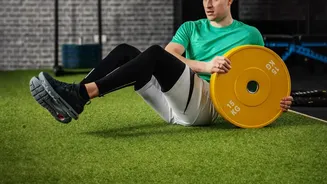
Once you have mastered the basic form, you can modify the exercise to suit your needs. For a greater challenge, hold a light weight like a dumbbell or a medicine ball close to your chest. Extending your arms straight out in front of you while holding the weight will increase the intensity further by creating a longer lever, forcing your core to work harder to stabilise. You can also use a resistance band anchored to a stable object like a pole or doorframe. Stand sideways to the anchor point and pull the band across your body, focusing on resisting the band's pull on the return. For those who find the movement difficult, simply reduce the range of motion. Even a small, controlled twist is more effective than a large, sloppy one.