







Meet CAPSTONE: The Little Satellite with a Big Job
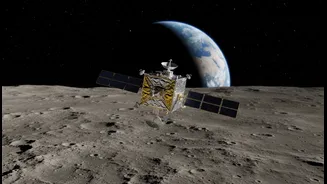
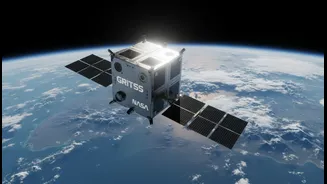
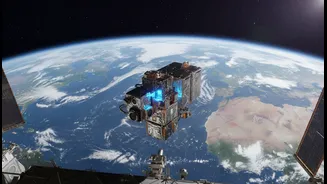
Launched in June 2022, the Cislunar Autonomous Positioning System Technology Operations and Navigation Experiment, or CAPSTONE, is a 25-kilogram pathfinder mission. Owned and operated by the commercial company Advanced Space for NASA, its primary job
was never to be a permanent outpost, but to test critical technologies in the challenging environment of deep space. After successfully completing all its primary and extended mission objectives by June 2026, NASA's direct involvement concluded, but the spacecraft continues to operate as a commercial technology testbed. This distinction is key: CAPSTONE is a scout, not a settlement. It’s a trailblazer sent ahead to map the terrain and test new tools, making the journey safer and more efficient for those who will follow.
Solving a GPS Problem for the Moon
On Earth, we take GPS for granted. But around the Moon, there's no such system. Historically, spacecraft have relied on constant communication with Earth-based antennas to figure out where they are. This is slow, expensive, and unsustainable as lunar traffic increases. CAPSTONE was sent to prove there's a better way. Its secondary objective was to test the Cislunar Autonomous Positioning System (CAPS). This groundbreaking technology allows spacecraft to determine their position autonomously, either by communicating with each other or through onboard systems, dramatically reducing the reliance on Earth. In one experiment, CAPSTONE communicated with NASA's Lunar Reconnaissance Orbiter (LRO) to calculate its own position, a key demonstration of peer-to-peer navigation. This technology is foundational for a future where dozens of missions can operate at the Moon simultaneously without overwhelming ground control.
Testing a New 'Gateway' Orbit
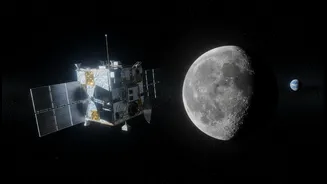
One of CAPSTONE's most important tasks was to be the first to fly in a special orbit called a Near-Rectilinear Halo Orbit (NRHO). This highly elliptical path is located at a precise balance point between the gravity of the Earth and the Moon. The benefit is stability; it requires minimal fuel to maintain, making it an ideal staging point for missions. This is the very same orbit that was planned for the Lunar Gateway, envisioned as a future orbiting outpost for astronauts. By successfully operating in the NRHO for years, CAPSTONE has provided invaluable real-world data, confirming simulations and reducing the risks for much larger, more complex missions that will use this pathway. It proved the orbit was stable and a viable location for long-term operations.
Technology Test, Not a Station
This is where the most important distinction lies. CAPSTONE is a technology demonstrator, not a station. A space station like the Gateway is designed as a destination—a habitat and laboratory for astronauts, with docking ports for multiple visiting spacecraft. It is a large, complex piece of infrastructure intended for long-term human support. CAPSTONE, by contrast, is a tiny, unmanned CubeSat built for a specific, limited purpose: to test technologies and verify an orbit. It gathered data, proved concepts, and then its primary mission ended. Its success is not measured in how many astronauts it can house (zero), but in the knowledge and experience it provided. Think of it this way: CAPSTONE was the person sent to survey the land and test the soil; the Gateway is the city that will be built on that foundation.
Why This Matters for India's Ambitions
The success of CAPSTONE is not just a win for NASA, but for all space-faring nations, including India. As ISRO continues to expand its own lunar exploration program, the technologies proven by CAPSTONE offer a clear roadmap. The development of autonomous navigation systems is crucial for managing complex missions without total dependence on ground infrastructure. Furthermore, the validation of the NRHO provides a stable, internationally understood staging point for future missions, fostering collaboration and interoperability. By pioneering these capabilities, low-cost missions like CAPSTONE lower the barrier to entry for ambitious cislunar operations, allowing countries like India to leverage these proven methods. This accelerates the shared goal of creating a sustainable, bustling economy and a permanent human presence in the Earth-Moon system.