
A New Window to the Cosmos
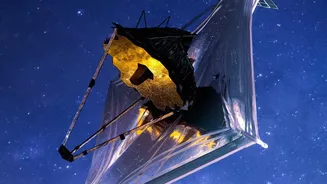
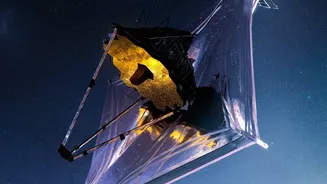
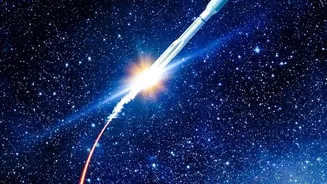
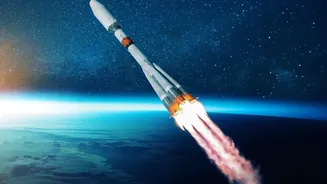
On August 30, 2026, a SpaceX Falcon Heavy rocket carried NASA's latest flagship mission, the Nancy Grace Roman Space Telescope, into space. Now journeying to its observation point about 1.5 million kilometres from Earth, Roman is poised to begin a new
era of cosmic discovery. Named after Nancy Grace Roman, NASA's first chief of astronomy and a key figure behind the Hubble Space Telescope, this observatory is designed to tackle some of the biggest questions in astrophysics. Its primary mission, slated to last five years, focuses on two profound mysteries: the nature of dark energy and the census of planets beyond our solar system, known as exoplanets. After a commissioning phase of about three months, the telescope is expected to begin its science operations and deliver its first images in early 2027.
The Power of the Big Picture
What truly sets Roman apart from its famous predecessors, Hubble and the James Webb Space Telescope (JWST), is its immense field of view. While Hubble and JWST act like zoom lenses, capturing incredibly detailed images of small patches of the sky, Roman functions like a wide-angle lens. It has the same size primary mirror as Hubble (2.4 meters) but features a Wide Field Instrument that can image an area at least 100 times larger with comparable sharpness. This capability will allow Roman to survey vast swathes of the sky with incredible speed. In its initial five-year mission, it is expected to observe 50 times more of the sky than Hubble has in over 30 years, creating gigantic cosmic panoramas that will serve as a treasure map for astronomers for decades to come.
Mapping the Universe's Infancy
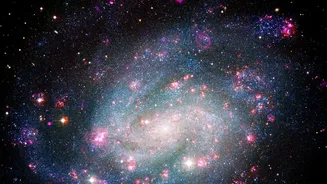
This panoramic view is key to studying the early universe. To understand how the cosmos evolved from its fiery birth to the sprawling structure of galaxies we see today, scientists need to create massive, three-dimensional maps of the universe through time. Roman's ability to quickly image billions of galaxies over huge areas will provide exactly that. By observing how galaxies are clustered together at different cosmic distances, scientists can trace the history of cosmic expansion. This allows them to study the imprints of sound waves, called baryon acoustic oscillations, that rippled through the primordial universe and 'froze' in place, influencing the large-scale structure we see today. Mapping this structure helps reveal how the universe grew and evolved, giving us a clearer picture of its youth.
Chasing the Ghosts of the Cosmos
Two of the biggest puzzles in cosmology are dark energy and dark matter. Dark energy is the mysterious force believed to be causing the universe's expansion to accelerate, while dark matter is the unseen substance that provides the gravitational scaffolding for galaxies. Roman will probe these phenomena using multiple techniques. By creating vast maps of galaxies, it will study how dark energy has influenced cosmic expansion over time. It will also use a technique called weak gravitational lensing, measuring the tiny distortions in the light from distant galaxies caused by the gravity of dark matter. These measurements will create a map of the universe's dark matter distribution, helping to solve a fundamental mystery about the cosmos's composition.
A Census of Distant Worlds
Beyond cosmology, Roman is set to be an exoplanet-finding machine. While the Kepler and TESS missions found thousands of planets by looking for the dimming of a star's light as a planet passes in front (the transit method), Roman will primarily use a different technique called gravitational microlensing. This method detects planets by observing how their gravity, and that of their host star, bends and magnifies the light from a more distant, background star. This technique is sensitive enough to find planets with masses as small as Mars and even rogue planets that drift through the galaxy without a parent star. It is expected that Roman could discover tens of thousands of new exoplanets, providing a revolutionary new census of the worlds that populate our Milky Way.